Category:Children--1900s (film subject)
Children--1900s (film subject)
.
.
- Category:Children--1890s (film subject)
- Category:Children--1900s (film subject)
- Category:Children--1910s (film subject)
- Category:Children--1920s (film subject)
- Category:Children--1930s (film subject)
- Category:Children--1940s (film subject)
- Category:Children--1950s (film subject)
- Category:Children--1960s (film subject)
- Category:Children--1970s (film subject)
- Category:Children--1980s (film subject)
- Category:Children--1990s (film subject)
- Category:Children--2000s (film subject)
- Category:Children--2010s (film subject)
- Category:Children--2020s (film subject)
.
The Evolution of the Cinematic Child (1900–1909)
. Between 1900 and 1909, the depiction of children on screen shifted from passive documentary actualities into complex narrative catalysts driving early film grammar. As runtimes expanded, the multi-shot "rescue thriller" and early social realism weaponized childhood vulnerability to pioneer cross-cutting and parallel editing. Landmark films like Rescued by Rover (1905), The Adventures of Dollie (1908), and The Lonely Villa (1909) relied on the "child-in-peril" trope to establish cinematic pacing and generate visceral audience empathy.
Concurrently, child performance achieved unprecedented dramatic agency and emotional depth. Rather than remaining passive victims, young actors began driving plot resolution, as seen in Alice Guy-Blaché's Le Fils du garde-chasse (1906). Under D.W. Griffith at Biograph, stock child actors like Gladys Egan pioneered a naturalistic performance style that replaced adult theatrical histrionics with subtle emotional realism. Egan's understated acting in The Country Doctor (1909) anchored complex ethical dilemmas, while Griffith utilized the static, gaunt presence of hungry children in A Corner in Wheat (1909) as visual iconography to critique industrial greed.
Finally, children became vehicles for genre expansion and industry self-reflexivity. In Edwin S. Porter's The Little Train Robbery (1905), an all-child cast executed cinema's first structural parody by deliberately mimicking adult Western tropes, while shorts like A Scrap in Black and White (1903) documented the persistent racialized caricature traditions inherited from vaudeville. Though the formal star system did not yet exist and child actors remained uncredited, casting practices moved decisively away from casual domestic circles toward a professional reliance on disciplined juvenile ensembles, cementing the child as the emotional heart and narrative engine of early narrative cinema.
Top films (year by year)
1900
- Oct 1900 -- The House That Jack Built (Smith), film -- Harold Smith & Dorothy Smith -- Directed and produced by George Albert Smith, this short silent trick film features his children, Harold and Dorothy, playing with building blocks in an indoor nursery setting. Harold aggressively knocks down his sister's newly constructed toy house, much to her distress. Smith then reverses the film reel inside the projector, causing the blocks to magically fly back into place to the girl's delight. The production is highly significant as it integrates the children’s physical performance with early cinematic special effects—using reverse-motion editing to visualize a child's internal psychological wish-fulfillment. <EXTANT; online YES>
- Nov 1900 -- Grandma's Reading Glass (Smith), film -- Harold Smith -- Directed by George Albert Smith and distributed by the Warwick Trading Company, this monumental trick film features Smith's young son, Harold, as the principal protagonist. The boy borrows his grandmother's oversized magnifying glass to inspect a series of domestic objects. Historically celebrated as one of the most important milestones in early cinema, the film cuts between medium shots of the child and subjective, masked circular close-ups of his specific points of view (a watch, a canary, a cat, and his grandmother's eye). It established the foundational building blocks of modern film grammar and subjective visual editing. <EXTANT; online YES>
1901
- Aug 01, 1901 -- Boys Diving, Honolulu (Biograph/Bonine), film -- Uncredited Hawaiian boys -- Filmed on location by Robert Kates Bonine for the American Mutoscope & Biograph Company. The stationary lens captures a large group of native young boys positioned en masse on a narrow pier jutting over the harbor, silhouetted against a scenic background featuring six anchored clipper ships. The children function as the absolute spectacle of the frame, repeatedly jumping, diving, and competing to retrieve coins thrown into the shallow water by someone off-screen. Running 27 seconds at 16 frames per second, it serves as an invaluable, early non-fiction record of indigenous childhood leisure culture adapted into an early industrial visual attraction.
- Dec 1901 -- Children Bathing / The Kiddies Go in Bathing (Edison/Blackton), film -- Uncredited tiny tots -- Directed and produced by J. Stuart Blackton and Albert E. Smith for the Edison Manufacturing Company. Shot on location along the Atlantic coast, the short captures two very small children navigating the breaking surf, splashing and tumbling into the ocean waves with complete, uncoached delight. Contemporary Edison trade catalogs heavily promoted the title as a premiere study of "Child-life," praising its crisp high-contrast water effects. The film is structurally vital for documenting how early distribution monopolies weaponized the visceral, universal charm of early childhood to secure safe, broad box-office appeal.
1902
- Jul 15, 1902 -- Jack and the Beanstalk (Porter/Fleming), film -- Thomas White -- (Porter/Fleming), film -- Thomas White -- Produced by the Edison Manufacturing Company, this is one of the earliest substantial American fairy-tale films. Young Thomas White stars as Jack, navigating a series of ten sequential narrative shots that made the production twice as long as any previous studio project. The film is uniquely significant to performance history because the title character is explicitly cast as a child rather than an adult actor playing down in age. Its sophisticated deployment of dissolves, stop-camera substitutions, and multi-shot interior/exterior transitions helped establish the grammar of early fantasy cinema. <EXTANT; online YES>
- Dec [23,] 1902 -- The Little Match Seller (Williamson), film -- Uncredited young girl -- (Williamson), film -- Uncredited young girl -- Directed by James Williamson, this faithful British adaptation of Hans Christian Andersen's classic fable centers entirely on a destitute, barefoot young girl trying to sell matchsticks in the freezing winter cold. Abandoning the typical lighthearted trick-film comedic framework, Williamson utilizes advanced double-exposure and superimposition optical techniques to project the child's tragic inner emotional life—visualizing her desperate fantasies of warmth, food, and family directly onto a bleak brick wall. It stands as a monumental masterpiece of the early Brighton School, establishing the child as both a central narrative driver and a deep vehicle for socio-political empathy. <EXTANT; online YES>
1903
- Jul 08, 1903 -- A Scrap in Black and White (Edison), film -- Uncredited young Black boy & white boy -- (Edison), film -- Charles "Kid" Finney & uncredited youth -- Photographed by A.C. Abadie on location at Brandywine Springs, Delaware, for the Edison Manufacturing Company. The staged sporting actuality captures an intense boxing match between a young Black boy and a white competitor. The two children exchange highly physical blows until collapsing from exhaustion, prompting the referee to count them out while corner seconds throw buckets of water over them. The short serves as an unusually explicit early documentation of the racialized entertainment culture of early industrial American cinema, while also preserving the oldest surviving motion-picture footage of Charles "Kid" Finney.
- Oct 17, 1903 -- Alice in Wonderland (Hepworth/Stow), film -- May Clark -- Alice in Wonderland (Hepworth/Stow), film -- May Clark -- Directed by Cecil Hepworth and Percy Stow, this production stands as the world's very first cinematic adaptation of Lewis Carroll's literature. Fourteen-year-old May Clark stars as Alice, appearing across an elaborate series of interior and exterior sets designed to mimic Sir John Tenniel's original book illustrations. Clark's performance is historically vital to early cinema grammar; her staging required strict physical synchronization to execute early trick photography, including scaled double-exposures to simulate shrinking in the Hall of Many Doors and growing trapped inside the White Rabbit's house. Running approximately twelve minutes in its original cut, it was the longest film produced in Great Britain at the time
1904
- Sep 1904 -- Children and Rabbits / AKA Kiddies and Rabbits (Warwick/Brown), film -- Uncredited young children -- Directed by Archibald Brown for the British Warwick Trading Company and distributed in North America by the Edison Manufacturing Company (Catalog #6032). The stationary lens captures a baby and two young toddlers sitting on the ground in an outdoor yard, surrounded by and interacting with a dense cluster of active rabbits while chickens feed in a background coop. Promoted directly in distributor catalogs as an exemplary baseline study of "child life," this surviving short marks an important evolutionary step in early commercial exhibition, demonstrating how international production houses systematically weaponized the naturalistic, unprompted expressions of infants as a primary visual attraction to secure safe box-office appeal.
1905
- 1905 -- Our New Errand Boy (Williamson), film -- Tom Williamson -- Directed by James Williamson for the Williamson Kinematograph Company. This British comedy stars the director's son, Tom Williamson, as a mischievous young grocery clerk who transforms standard neighborhood deliveries into a series of calculated practical jokes. Historically cited by scholars as a foundational milestone for the recurring child performer, Tom Williamson functioned as one of cinema's very first professional child actors, appearing in a succession of targeted comedic roles for his father's studio. The film's final, complex panning chase sequence directly anticipated the slapstick formulas that would define the next decade of commercial film grammar.
- Jul 1905 -- Rescued by Rover (Fitzhamon/Hepworth), film -- Barbara Hepworth & May Clark -- Directed by Lewin Fitzhamon and produced by Cecil Hepworth. This pioneering British narrative tracks the dramatic kidnapping of a baby girl from her nursery by a vengeful beggar woman and her subsequent tracking and rescue by the family's collie, Rover. The infant is portrayed by Barbara Hepworth, the producer's real-life infant daughter, while adolescent studio mainstay May Clark portrays the negligent nursemaid. The short is uniquely critical to performance history: rather than functioning as an incidental backdrop prop, the infant serves as the structural narrative catalyst, with early continuity editing systematically generating cross-cut suspense around her physical presence.
- Sep 01, 1905 -- The Little Train Robbery (Porter), film -- Uncredited child ensemble -- Directed and photographed by Edwin S. Porter for the Edison Manufacturing Company. Shot between August 3 and August 23, 1905, on location at Olympia Park in Connellsville, Pennsylvania, this short runs approximately eleven minutes as a direct, tongue-in-cheek parody of Porter's own 1903 blockbuster The Great Train Robbery. Utilizing a miniature amusement park railway and playhouse sets, the all-child cast assumes roles typically reserved for adult Western outlaws, with a young girl cast as the "Bandit Queen" who leads a train heist to seize dolls and candy. It stands as a vital cinematic milestone, demonstrating an early ensemble of child actors collectively mimicking adult genre conventions within a fully scripted fictional framework.
- Dec 16, 1905 -- The Night Before Christmas (Porter), film -- Uncredited children -- [Harry Eytinge &] uncredited children -- Directed by Edwin S. Porter for the Edison Manufacturing Company as the first cinematic adaptation of Clement Clarke Moore's 1823 seasonal poem. The multi-scene narrative tracks a large family of children who hang their stockings, engage in a chaotic bedroom pillow fight, and eventually creep downstairs to discover their presents. While the child ensemble remains uncredited in early Edison logs, Santa Claus is performed by character actor Harry Eytinge. The film marks an important evolutionary bridge, integrating an active cast of children into a complex, commercially driven holiday narrative that utilized miniature models, panoramic backdrops, and advanced intertitle text formatting.
1906
- Apr 20, 1906 -- Le Fils du garde-chasse (Guy), film -- Uncredited boy -- Directed by Alice Guy-Blaché for Gaumont and filmed entirely on location in the Fontainebleau forest. This French silent melodrama tracks a gamekeeper's eldest son who witnesses his father being violently murdered by poachers. Breaking away from the era's standard passive childhood depictions, the narrative grants the boy immense dramatic agency: he shadows the killers, alerts his family, executes a knife strike to avenge his father, and secures a formal commendation from the local police forces. The short represents a monumental evolution in early film grammar, integrating ten continuity-edited shots and pioneering deep-focus landscape cinematography to present a child as a primary heroic protagonist.
- May 01, 1906 -- The Terrible Kids (Porter), film -- Uncredited boy ensemble & dog -- Directed and photographed by Edwin S. Porter for the Edison Manufacturing Company. The multi-scene narrative follows a mischievous duo of young street urchins and their stray dog who systematically terrorize a local neighborhood by destroying property, picking fights, and outsmarting local authority figures. The short is exceptionally significant to the history of child performers; it marks the earliest verified American ensemble comedy where a structured collective of children deliberately mimics and dismantles adult social codes to drive an entire cinematic plot. The film was an enormous box-office success, setting the blueprint for the juvenile-delinquent slapstick genre.
1907
- Nov 09, 1907 -- A Little Hero (Vitagraph), film -- Uncredited child -- Produced by the Vitagraph Company of America and directed by J. Stuart Blackton. This short silent narrative stars seven-year-old Kenneth Casey as a courageous young boy who enters a dangerous situation to execute a heroic, life-saving rescue. The production stands as an essential evolutionary milestone for the American star system; it marks one of the earliest instances where Vitagraph systematically groomed and marketed a specific child actor (Kenneth Casey) as a recurring box-office draw. The film helped solidify the "juvenile hero" archetype, shifting American narrative conventions away from loose, unscripted actualities toward highly structured, character-driven dramatic shorts.
1908
- Jan 16, 1908 -- Rescued from an Eagle's Nest (Porter), film -- Jinnie Frazer -- Produced by Edwin S. Porter for the Edison Manufacturing Company, this action-melodrama serves as a crucial transitional piece in early American narrative film grammar. The plot follows a young child, portrayed by child actress Jinnie Frazer, who is snatched from her outdoor cradle by a giant eagle and carried away to a cliffside nest, prompting a dramatic rescue by her woodsman father. The film is historically celebrated for featuring future directing legend D.W. Griffith in his first major on-screen acting role as the father. Structurally, it utilizes the extreme peril of a child protagonist to execute a complex, multi-shot rescue sequence, combining theatrical wire special effects with real outdoor location work to generate cinematic tension.
- Jul 14, 1908 -- The Adventures of Dollie (Griffith), film -- Child actress unidentified -- This landmark production marks the official directorial debut of D.W. Griffith for the American Mutoscope & Biograph Company. The narrative centers on a young girl named Dollie who is kidnapped from her family lawn by a vengeful peddler, sealed inside a large wooden barrel, and accidentally lost in a river current heading downstream toward a dangerous waterfall. While historically monumental for its progressive use of cross-cutting to build structural cinematic suspense, the true identity of the child actress remains securely unidentified. Though early retrospective lists misattributed the role to Gladys Egan, surviving studio payroll logs prove Egan had not yet joined the company, leaving the screen's first true "child-in-peril" protagonist anonymous.
- Jul 28, 1908 -- The Red Man and the Child (Griffith), film -- John Tansey -- Directed by D.W. Griffith for the American Mutoscope & Biograph Company and filmed entirely on location along the Passaic River in Little Falls, New Jersey. This early Western stars six-year-old John Tansey (credited as Johnny Tansey) as a young boy who forms a deep protective bond with a local Sioux man. When a band of outlaws murders the child’s grandfather to steal a cache of gold, the boy is taken hostage, prompting a high-stakes canoe pursuit and rescue by his Native American ally. The film is uniquely valuable to child performance research because Tansey's performance was explicitly credited in studio documentation, expanding the parameters of early silent acting by requiring a child to convey complex stages of grief and terror.
- Cf. Sep 24, 1908 -- The Fairylogue and Radio-Plays (Boggs/Turner), lost film -- Romola Remus -- An extraordinary, highly ambitious multimedia production created and narrated live by author L. Frank Baum to adapt his early Oz literature. This experimental show combined live theatrical stage performance, hand-tinted motion picture reels, magic lantern slides, and a live orchestral score. Eight-year-old Romola Remus stars as Dorothy Gale, making her the first child actress to portray the iconic literary heroine on screen. While the underlying film material is now officially lost due to nitrate decomposition, surviving scripts and production stills verify that a genuine child actor was intentionally cast to anchor this massive commercial franchise, launching Remus into a prolific early career across the stage and silent screen.
- Dec 22, 1908 -- The Christmas Burglars (Griffith), film -- Adele DeGarde -- Directed by D.W. Griffith for the Biograph Company. The seasonal urban melodrama stars seven-year-old Adele DeGarde as Margie, the destitute daughter of a struggling, widowed mother. Desperate for food, the child writes a poignant letter to Santa Claus listing her Broome Street apartment address, which is dropped accidentally and recovered by a gruff local pawnbroker who undergoes a sudden change of heart. To deliver a tree and food without shattering the child's holiday illusions, the pawnbroker hires a duo of professional burglars to covertly decorate the room while the family sleeps. This film is historically vital as it marks the official film debut of Adele DeGarde, documenting the studio's early calculated transition toward marketing recognizable, recurring child stars.
1909
- Jul 08, 1909 -- The Country Doctor (Griffith), film -- Gladys Egan & Adele DeGarde -- This celebrated Biograph melodrama centers on a local physician, Dr. Harcourt, who is abruptly summoned away from the bedside of his own critically ill daughter, Edith, to save a destitute neighbor's dying child. Gladys Egan delivers a highly realistic dramatic performance as Edith Harcourt, while Adele DeGarde portrays the sick child of the impoverished family. The children's mirroring illnesses and the father's agonizing moral choice provide the central psychological conflict of the narrative. It stands as one of the most important early American silent films for studying dramatic child performance, with the contemporary trade press heavily praising its emotional weight and stark naturalism.
- Aug 26, 1909 -- The Seventh Day (Griffith), film -- Gladys Egan & John Tansey -- A Biograph domestic drama starring child actors Gladys Egan and John Tansey as two siblings caught in the middle of their high-society parents' bitter divorce proceedings. The judge rules that the neglectful, socialite mother may only retain custody if she can actively demonstrate her children's genuine affection within a one-week deadline. The short belongs to the remarkable series of 1909 Biograph productions that systematically elevated Egan into one of cinema's very first recognizable, professional contract child performers. It remains crucial to performance history as a document of the industrial shift away from casual, anonymous childhood appearances toward a structured studio system.
- Sep 13, 1909 -- The Children's Friend (Griffith), film -- Gladys Egan & Adele DeGarde -- This Biograph children's adventure short tracks a group of young children who inadvertently become separated and lost during a rural outdoor outing, prompting their parents to locate their exact wilderness whereabouts using a trained carrier pigeon. Gladys Egan and Adele DeGarde are both explicitly featured and credited in studio logs. The production serves as an essential stepping stone for mapping the industrial emergence of a specialized, recurring juvenile stock ensemble at Biograph, replacing the casual use of unscripted background children with disciplined, expressive actors.
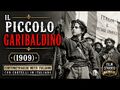
- Dec [15,] 1909 -- Il piccolo garibaldino / The Garibaldi Boy (Alberini), film -- Uncredited child -- Produced by Filoteo Alberini for the Cines studio, this historical melodrama is a major European cultural milestone for weaponizing childhood within a highly patriotic and melodramatic context. Based loosely on the Spedizione dei Mille, it follows a twelve-year-old boy, Augusto, who runs away from home to secretly enlist in Giuseppe Garibaldi's volunteer army, ultimately dying a hero's death on the battlefield after kissing his general's sword. While the young lead remains uncredited, his parents are portrayed by silent cinema fixtures Mario Caserini and Gemma De Ferrari. Heavily influenced by the literary themes of Edmondo De Amicis' Cuore, this surviving, tinted short pioneered the recurring European subgenre of wartime juvenile sacrifice
Media in category "Children--1900s (film subject)"
The following 8 files are in this category, out of 8 total.
 1900.jpg 226 × 226; 5 KB
 1901 Bonine (doc).jpg 1,000 × 1,500; 69 KB
 1902 Williamson (short).jpg 230 × 345; 16 KB
 1903 Abadie (short).jpg 190 × 281; 10 KB
 1905 Porter (short).jpg 190 × 281; 12 KB
 1905 Williamson (short).jpg 200 × 302; 27 KB
 1906 Guy-Blache (short).jpg 254 × 368; 11 KB
 1909 Alberini (film).jpg 640 × 480; 92 KB


