Category:Pharisees (subject)
The Pharisees were one of the religious parties of Second Temple Judaism.
< Preaching of John the Baptist -- Teaching about the Law -- Recruiting the Tax Collector (Mark, Matthew) -- Question about Fasting -- Dumb Man -- Man with a Withered Hand -- Jesus and Beelzebul -- Demand for a Sign -- Tradition of the Elders -- Beware of Yeast -- Teaching about Divorce -- Wicked Husbandmen -- Tribute to Caesar -- Great Commandment -- Question about the Son of David -- Woe to the Scribes -- Guard at the Tomb >
Overview
During the late Second Temple period, the Pharisees became the most popular opposition party against the leadership of the ruling party of the Sadducees. The Pharisees represented the interests of "middle-class" Jews, especially Levites.
Religiously, the Pharisees were a reform movement. They emphasized the centrality of the Torah and its moral commitments, more that the sacrificial system of the Temple. They strongly promoted the observance of purity laws outside the Temple. According to Josephus, they stressed human freedom, but recognized that such a freedom was somehow limited by the spread of evil. They believed in the end of time or in the coming of an eschatological Messiah (the Son of David). They considered normative not only the five books of Moses, but also the Prophets and the Tradition of the Fathers.
While competing with the Sadducees, the Pharisees did not attack directly their authority and the authority of the Temple and priesthood. They relied on the large consensus they had among the masses to promote their reforms. Especially under the Hasmoneans the Pharisees were subjected to persecution, but their strength proved to be greater of any attempt to suppress them.
The attitude of the Pharisees toward more radical groups of opponents (Essenes, Zealots, Early Christians, etc.) was somehow ambivalent. On one hand they strongly fought against their radical views; on the other, they often defended them against the Sadducees, never recognizing to the Sadducees the right to suppress their opponents.
The Pharisees were active in Judea but also in Galilee (see Josephus, Life 196-197; Ant 18:4,23).
The Pharisees had a role of leadership at the beginning of the Jewish War, when Ananus ben Ananus succeeded in creating a government of national unity with the Sadducees, the Pharisees and the Essenes. As the revolt progressed, however, the more moderate parties were marginalized and the Pharisees also lost enthusiasm in the cause. They took a midway position (neither with the rebels nor with the Romans) which on the long run allowed them to survive and prosper. It is generally maintained that the Pharisees were the most important and dynamic component in the coalition that after the Jewish War]] generated Rabbinic Judaism.
The Pharisees in ancient sources
The Pharisees in early Christian sources
The Pharisees in Scholarship
1. Pre-critical and Early Modern Stage (Patristic era – 18th century)
The term "Pharisees" had been commonly deployed by Christians as an epithet against their Christian opponents long before the Pharisees became subject of scholarly inquiry. Pharisees were generally studied through the lens of the New Testament polemics and the Church Fathers, with a negative image (hypocrisy, legalism).
In the 16th–18th centuries, antiquarians and Christian Hebraists began comparing Josephus, rabbinic literature, and the NT, but the framework remained confessional and polemical.
2. Classical Critical Stage (19th century – early 20th century)
The Pharisees became central to the story of the “rise of rabbinic Judaism.”
Scholars saw them as the forerunners of the rabbis, the “party of the synagogue” as opposed to the Sadducees (“party of the Temple”).
Key figures & works:
- In 1857 Abraham Geiger is credited for initiating the modern study of the Pharisees and Sadducees viewed not as "sects" but as representatives of two broad "tendencies" (Tendenzen) within Second Temple Judaism. Geiger argued that the Pharisees were the liberalizing, progressive movement that emerged after the Maccabean revolt; they were opposed to the conservative Sadducees, representing the ruling elite, the priests of the Jerusalem Temple. The Pharisees became increasingly dominant. By the second century CE, Rabbinic Judaism, built on Pharisaism, arose. In Judaism and Its History (1867), Geiger claimed that Jesus himself was "a Pharisee who walked in the way of Hillel"; his teaching was nothing new until it was re-elaborated by the ignorant Jews of Galilee who were inclined to apocalyptic phantasies.
- Emil Schürer, The History of the Jewish People in the Age of Jesus Christ (1st German ed. 1886–90; revised English ed. 1973–87) -- Still a landmark. Offers a systematic survey of Jewish groups, portraying the Pharisees as proto-rabbis and leaders of popular religion. The revised English edition (1973–87, Vermes et al.) kept this work standard for decades. Foundational, systematic survey.
- Julius Wellhausen, Israelitische und jüdische Geschichte (1894) -- Wellhausen and the religionsgeschichtliche Schule interpreted the Pharisees as a popular lay movement in opposition to priestly elites. Strongly influenced later reconstructions, especially the "party" model.
- Early Jewish historians (e.g., Graetz) valorized them as champions of Jewish continuity.
3. Mid-20th Century Revisions (1930s–1970s)
Growing emphasis on rabbinic sources and on seeing Pharisees as proto-rabbis, rather than NT caricatures.
Christian scholars started reassessing anti-Pharisaic polemics in the Gospels (e.g., Matthew 23).
Key works:
- George Foot Moore, Judaism in the First Centuries of the Christian Era (1927–30) -- Broader than just Pharisees, but offered a sympathetic view of their piety. Corrected Christian stereotypes by stressing continuity between Pharisees and later Judaism.
- Louis Finkelstein, The Pharisees (2 vols., 1938, rev. ed. 1962) -- Classic Jewish defense of the Pharisees. Emphasized their democratic, lay character and lasting influence on Judaism. For decades the standard Jewish interpretation. Influential reconstruction, stressed their role as a lay-pietist movement.
- Goodenough, and Bickerman also contributed alternative perspectives.
The Neusner Revolution (1960s-1970s)
Jacob Neusner, multiple works from the 1960s–70s, especially From Politics to Piety (1973): argued for the “myth” of Pharisees as proto-rabbis, insisting on discontinuity between pre-70 Pharisees and later rabbinic Judaism.
Key works:
- Jacob Neusner, From Politics to Piety: The Emergence of Pharisaic Judaism (1973). -- Provocative. Argued that Pharisees were not proto-rabbis but a political group whose post-70 survivors later redefined themselves in religious, pietistic terms. Sparked decades of debate.
- Jacob Neusner, The Rabbinic Traditions about the Pharisees before 70 (3 vols., 1971) -- Comprehensive analysis of rabbinic traditions. Concluded that later rabbinic sources could not be uncritically projected back to the pre-70 Pharisees.
- Elias Bickerman, essays in Studies in Jewish and Christian History (1976) -- Stressed the political role of Pharisees in Hasmonean and Herodian society.
5. Post-Neusner Debate and the Pluralism of Second Temple Judaism (1980s–2000s)
Neusner provoked a rethinking: were Pharisees really rabbinic ancestors, or just one group among many in Second Temple Judaism?
The Dead Sea Scrolls contextualized Pharisees within a more diverse sectarian landscape.
Growing Jewish-Christian dialogue tempered older caricatures.
Key works:
E.P. Sanders, Paul and Palestinian Judaism (1977): reframed “covenantal nomism,” indirectly rehabilitating Pharisaic piety against Christian charges of “legalism.”
Anthony Saldarini, Pharisees, Scribes and Sadducees in Palestinian Society (1988): social-historical model; Pharisees as a broad lay movement with political clout.
Shaye J.D. Cohen, From the Maccabees to the Mishnah (1987): influential synthesis.
6. Recent Scholarship (2000s–today)
Pharisees seen less as a monolithic party and more as a spectrum of positions, whose portrayal varies between Josephus, the NT, and rabbinic texts.
Emphasis on the limits of our evidence: most sources are hostile, retrospective, or polemical.
Renewed study of Josephus, the Scrolls, and archaeology enriches the picture.
Key works:
Steve Mason, Josephus and the New Testament (1992; 2nd ed. 2003): re-examines Josephus’s Pharisees.
Anders Runesson, Donald D. Binder, and Birger Olsson, The Ancient Synagogue from Its Origins to 200 C.E. (2008): situates Pharisees within synagogue history.
John P. Meier, A Marginal Jew, esp. vol. 3 (2001): careful reassessment of Gospel traditions about Pharisees.
Tal Ilan and others on gender and society, widening perspectives.
Joseph Sievers & Amy-Jill Levine (eds.), The Pharisees (2016): landmark collection, interdisciplinary and interfaith, reevaluating all evidence.
The Pharisees in Fiction
In movies the Pharisees are consistently presented as enemies of Jesus and hypocrites.
In Intolerance; or the Triumph of Love against Intolerance, Jesus represents "Love" while the Pharisees ("Certain Hypocrites among the Pharisees") represents "Intolerance".
In the Gospel according to Matthew, the words against the Pharisees are addressed against the Romans. Nonetheless Parolini peretuted some anti-Jewish stereotypes.
In Jesus of Montreal there is deliberately no reference to the Pharisees.
Related categories
References
- Pharisees / Roland Deines / T&T Clark Encyclopedia of Second Temple Judaism (2019 Stuckenbruck, Gurtner), dictionary
- Pharisees / Roland Deines / In: The Eerdmans Dictionary of Early Judaism (2010 Collins / Harlow), dictionary, 1061-1063
- / [[]] / In: The Anchor Bible Dictionary (1992 Freedman), dictionary,
External links
Pages in category "Pharisees (subject)"
The following 44 pages are in this category, out of 44 total.
1
- Trihæresium, seu de celeberrimis tribus, apud Judaeos, Pharisaeorum, Sadducaeorum, et Esseniorum sectis (1604 Serarius), book
- Christ at the House of Simon the Pharisee (1620 Rubens), art
- Exame das tradições farisaicas (Examination of Pharisaic Traditions / 1623 Acosta), book
- Matteh Dan; or, Kuzari Heleq Sheni (1714 Nieto), book
- Miscellaneous Discourses Relating to the Traditions and Usages of the Scribes and Pharisees in Our Saviour Jesus Christ's Time (1718 Wotton), book
- Disquisitio ex historia ecclesiastica et philosophica (1720 Colberg), book
- Christ at the House of Simon the Pharisee (1737 Subleyras), art
- De Pharisaismo Iudaeorum Alexandrino Commentatio (1846-50 Grossmann), book
- (+) Die Pharisäer und die Sadducäer (The Pharisees and the Sadducees / 1874 Wellhausen), book
- Essai sur les origines des partis saducéen et pharisien (1883 Montet), book
- Mary Magdalene in the House of Simon the Pharisee (1891 Béraud), art
- Pharisaism: Its Aim and Its Method (1912 Herford), book
- Pharisees (1912 Schmidt-Rottluff), art
- Studies in Pharisaism and the Gospels (1917-1924 Abrahams), book
- What the World Owes to the Pharisees (1919 Herford), book
- Was verdankt die Welt den Pharisäern? (1920 Herford), book (German ed.)
- The Pharisees (1924 Herford), book
- The Pharisees and Their Teachings (1929 Lauterbach), book
- The Pharisees: The Sociological Background of Their Faith, 2nd ed. (1940 Finkelstein), book
- Introduction to Pharisaism (1954 Davies), book
- Gesetz und Geschichte: Untersuchungen zur Theologie der jüdischen Apokalyptik und der pharisäischen Orthodoxie (1960 Rössler), book
- Paulus, die Pharisäer und das Neue Testament (1961 Baeck), book
- The Pharisees: The Sociological Background of Their Faith, 3rd ed. (1962 Finkelstein), book
- The Rabbinic Traditions about the Pharisees before 70 (1971 Neusner), book
- Pharisaism in the Making: Selected Essays (1972 Finkelstein), book
- From Politics to Piety: The Emergence of Pharisaic Judaism (1973 Neusner), book
- The Pre-Herodian Civil War and Social Debate (1974 Buehler), book
- A Hidden Revolution (1978 Rivkin), book
- Le logos et la lettre: Philon d'Alexandrie en regard des pharisiens (1988 Lévy), book
- The Hasideans and the Origin of Pharisaism (1988 Kampen), book
- パリサイ派とは何か : 政治から敬虔へ = From Politics to Piety: The Emergence of Pharisaic Judaism (1988 Neusner / Nagakubo), book (Japanese ed.)
- Pharisees, Scribes and Sadducees in Palestinian Society (1988 Saldarini), book
- Les pharisiens: histoire d'un parti méconnu (1990 Pelletier), book
- Jewish Law from Jesus to the Mishnah (1990 Sanders), book
- Flavius Josephus on the Pharisees (1991 Mason), book
- Examination of Pharisaic Traditions (1993 Acosta), book (English ed.)
- Farisei, sadducei, esseni = Pharisäer, Sadduzäer, Essener (Jewish Contemporaries of Jesus / 1993 @1991 Stemberger / Pontoglio), book (Italian ed.)
- Fariseismo e origini cristiane (1999 Penna), edited volume
2
- A farizeusok és a szadduceusok = Die Pharisäer und die Sadducäer (The Pharisees and the Sadducees / 2001 Wellhausen), book (Hungarian ed.)
- The Pharisees and the Sadducees = Die Pharisäer und die Sadducäer (2001 Wellhausen / Biddle), book (English ed.)
- La città divisa: Flavio Giuseppe, Spinoza e i farisei (2003 Proietti), book
- In Quest of the Historical Pharisees (2007 Neusner/Chilton), edited volume
- The Portrayals of the Pharisees in the Gospels and Acts (2015 Marshall), book
- I farisei (2021 Sievers, Levine), edited volume (Italian ed.)
Media in category "Pharisees (subject)"
The following 12 files are in this category, out of 12 total.
 1857 Geiger.jpg 907 × 1,360; 206 KB
 1914 * Charles.jpg 333 × 500; 34 KB
 1938 * Finkelstein.jpg 375 × 500; 104 KB
 1971 * Rivkin.jpg 335 × 499; 36 KB
 1973 * Bowker.jpg 324 × 499; 13 KB
 1991 * Stemberger.jpg 1,125 × 1,500; 123 KB
 1995 * Stemberger.jpg 307 × 475; 32 KB
 2006b Newman.jpg 320 × 499; 20 KB
 2021 Hadas-Lebel.jpg 322 × 499; 26 KB
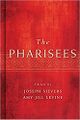 2021-E * Sievers Levine.jpg 332 × 499; 32 KB
 2021-T Sievers Levine.jpg 328 × 499; 13 KB
 2022 Yinger (book).jpg 1,000 × 1,500; 58 KB


