File:1997 Eisenman.jpg
Original file (400 × 620 pixels, file size: 33 KB, MIME type: image/jpeg)
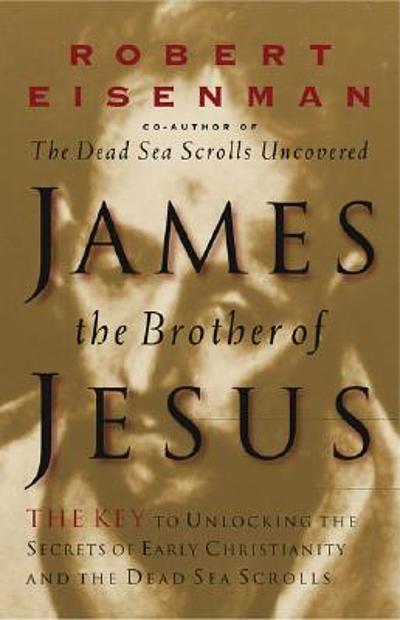
{en} Robert H Eisenman, James, the Brother of Jesus: The key to unlocking the secrets of early Christianity and the Dead Sea Scrolls (1997)
Abstract
"The author "establishes James--a figure almost entirely marginalized in the New Testament--as the leader of all opposition groups in the Jerusalem of his day and spiritual heir to his famous brother Jesus."--Jacket.
"In James the Brother of Jesus: The Key to Unlocking the Secrets of Early Christianity and the Dead Sea Scrolls, Robert Eisenman argues that James, the brother of Jesus, rather than Peter or Paul, was the central leader of the earliest Jesus movement in Jerusalem and that early Christianity originated as a rigorously Jewish, Torah-observant, apocalyptic movement closely related to the ideological world reflected in the Dead Sea Scrolls. Eisenman challenges the traditional Pauline-centered narrative of Christian origins, proposing that Paul represents a later, Hellenistic reinterpretation that transformed and marginalized the original Jewish messianic movement led by James ... The book reconstructs James as a charismatic and authoritative leader, known as “James the Just,” who upheld strict observance of Jewish law and represented a community of the poor and pious within Second Temple Judaism. Eisenman emphasizes the political and apocalyptic dimensions of the early Jesus movement, situating it within the broader spectrum of Jewish sectarianism, including Essenes, Zealots, and other radical groups. He argues that Jesus and his earliest followers were part of a nationalist and eschatological milieu that was subsequently spiritualized and universalized in later Christian tradition ... A central and controversial thesis of the book is the close connection between the Jerusalem church and the Qumran community. Eisenman proposes speculative identifications between figures in the Dead Sea Scrolls and early Christian leaders, most notably equating James with the Teacher of Righteousness and interpreting the Wicked Priest and the Kittim in light of early Christian and Roman contexts. He also identifies the “poor” (Ebionim) of Qumran with Jewish-Christian groups known from later patristic sources ... Eisenman devotes substantial attention to the conflict between James and Paul, interpreting Pauline texts and Acts as evidence of deep tensions over Torah observance, circumcision, and the inclusion of Gentiles. He portrays James as the guardian of Jewish orthodoxy within the Jesus movement and Paul as a controversial outsider whose theology ultimately reshaped Christianity into a religion distinct from Judaism ... The book draws extensively on canonical texts, the Dead Sea Scrolls, apocryphal and pseudepigraphal literature, and patristic sources, especially traditions concerning Jewish-Christian sects such as the Ebionites and Nazarenes. Methodologically, Eisenman combines philological analysis, historical reconstruction, and comparative sectarian studies, though his approach is often speculative and characterized by bold historical identifications ... While widely criticized for its conjectural identifications and polarized portrayal of early Christian diversity, James the Brother of Jesus has been influential in re-centering James and Jewish Christianity in scholarly discussions and in stimulating renewed debate about the relationship between Qumran and early Christianity."--
Table of Contents (2004 edition)
Reviews
External Links
File history
Click on a date/time to view the file as it appeared at that time.
| Date/Time | Thumbnail | Dimensions | User | Comment | |
|---|---|---|---|---|---|
| current | 05:39, 4 February 2026 | | 400 × 620 (33 KB) | Gabriele Boccaccini (talk | contribs) |
You cannot overwrite this file.
File usage
There are no pages that use this file.
