File:2006 Tabor.jpg



Original file (400 × 615 pixels, file size: 48 KB, MIME type: image/jpeg)
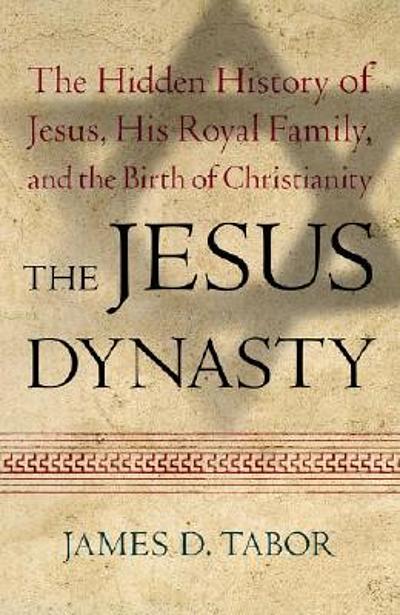
{en} Patrick J. Hartin, The Jesus Dynasty: The hidden history of Jesus, his royal family, and the birth of Christianity (New York : Simon & Schuster, 2006)
Abstract
"Based on a careful analysis of the earliest Christian documents and recent archaeological discoveries, The Jesus Dynasty offers a bold new interpretation of the life of Jesus and the origins of Christianity. Biblical scholar Tabor brings us closer than ever to the historical Jesus. He sheds new light on Jesus' relationship with John the Baptizer, the role played by his brother James, and how Paul's ministry transformed Jesus' message into what would become Christianity. Tabor has studied the earliest surviving documents of Christianity for more than thirty years. He reconstructs for us the movement that sought the spiritual, social, and political redemption of the Jews, a movement led by one family. This book offers an alternative version of Christian origins, one that takes us closer than ever to Jesus and his family and followers."--Publisher description.
"In The Jesus Dynasty, James D. Tabor presents a reconstruction of the historical Jesus and the origins of Christianity that emphasizes Jesus’ role as a Jewish messianic claimant embedded within Second Temple Jewish apocalypticism and dynastic expectations. Tabor argues that Jesus conceived of himself as a Davidic royal messiah and sought to establish a dynastic movement aimed at the restoration of Israel under divine rule. In this reconstruction, Jesus’ closest associate and relative, John the Baptist, is interpreted as a priestly messianic figure, and the two are portrayed as complementary leaders within a broader apocalyptic renewal movement ... Central to Tabor’s thesis is the claim that the early Jesus movement was fundamentally a family-based dynastic enterprise, with leadership intended to pass to Jesus’ brothers, particularly James, who assumed the role of leader after Jesus’ death. Tabor situates James as the uncontested head of the Jerusalem community and interprets early Christianity as a continuation of a Jewish reformist movement rather than the foundation of a new religion. He contrasts this original Jewish messianic movement with the later Pauline form of Christianity, which he argues transformed Jesus into a divine figure and universalized the movement among Gentiles, thereby eclipsing the original dynastic and Jewish character of the Jesus movement ... The book integrates canonical and non-canonical sources, Second Temple Jewish literature, and archaeological evidence, including speculative discussions of genealogies, family tomb traditions, and the Talpiot tomb hypothesis. Tabor also explores controversial possibilities concerning Jesus’ parentage and family background, while acknowledging the speculative nature of some of these reconstructions. Methodologically, the work combines historical-critical analysis with socio-political interpretation of messianism and sectarian movements in early Judaism ... Although the book has been influential in popular and scholarly discussions for its emphasis on dynastic messianism and the centrality of James, it has been widely criticized for its speculative hypotheses and for extending limited evidence beyond what many scholars consider methodologically warranted. Nevertheless, The Jesus Dynasty represents a significant contribution to the ongoing debate about the historical Jesus, early Jewish Christianity, and the diversity of early Christian origins."--
Contents
Preface : discovering the Jesus dynasty -- Introduction : a tale of two tombs -- A virgin shall conceive -- A son of David? -- An unnamed father of Jesus? -- Children of a different father -- The lost years -- A kingdom of this world -- The religion of Jesus the Jew -- Hearing the voice -- A crucial missing year -- Ushering in the kingdom -- Herod strikes -- Last days in Jerusalem -- The king is dead -- Dead but twice buried -- Go to James the Just -- The challenge of Paul -- The legacy of the Jesus dynasty -- The end of the age -- Conclusion : recovering lost treasures.
External links
- [ Google Books]
File history
Click on a date/time to view the file as it appeared at that time.
| Date/Time | Thumbnail | Dimensions | User | Comment | |
|---|---|---|---|---|---|
| current | 06:03, 4 February 2026 | | 400 × 615 (48 KB) | Gabriele Boccaccini (talk | contribs) |
You cannot overwrite this file.
File usage
There are no pages that use this file.
