File:1963 Schmithals.jpg


1963_Schmithals.jpg (340 × 500 pixels, file size: 26 KB, MIME type: image/jpeg)
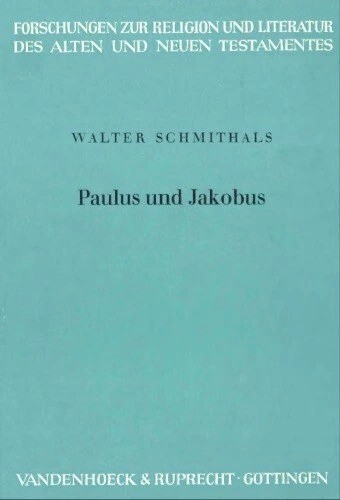
Paulus und Jakobus <German> / Paul and James (1963) is a book by Walter Schmithals.
Abstract
Walter Schmithals's Paulus und Jakobus: Studien zur Apostelgeschichte und zur paulinischen Theologie (1963) is a significant contribution to twentieth-century New Testament scholarship, offering a nuanced exploration of the relationship between Paul and James against the backdrop of early Christian diversity. Schmithals engages critically with the major sources—Acts of the Apostles, the Pauline letters (especially Galatians), and the Epistle of James—while integrating insights from patristic tradition and contemporary historiography.
The study begins by challenging the prevailing dichotomous interpretations rooted in the nineteenth-century Tübingen School, which often cast Paul and James as antagonists in a conflict between "gentile Christianity" and "Jewish Christianity." Instead, Schmithals argues for a more complex and dynamic relationship, wherein Paul and James represent complementary theological currents within the nascent church: Paul's universalistic and faith-centered approach is juxtaposed with James's rootedness in the ethical and communal traditions of Jewish Christianity. Schmithals maintains that their positions are not inherently oppositional but, when viewed in context, emerge as part of a broader dialogue that shaped Christian belief and practice.
A substantial section of the work is devoted to the literary and theological analysis of the Epistle of James. Schmithals refutes the notion that this text should be understood as explicitly "anti-Pauline." He interprets the epistle as an exemplar of Jewish-Christian wisdom literature, stressing the importance of faith manifested in ethical action—thus clarifying its function within a community concerned with practical discipleship amid social and religious change.
The book also scrutinizes the editorial strategies of Luke in Acts, arguing that the narrative construction both harmonizes and highlights underlying tensions among early Christian leaders—Peter, Paul, and James—and illustrates the plurality of models for authority and spirituality at the movement’s core.
Methodologically, Schmithals employs rigorous historical, philological, and literary criticism to reconstruct the apostolic landscape, emphasizing the creative pluralism of early Christian thought and leadership. He resists reductionist accounts that privilege conflict over dialogue and innovation over tradition, instead portraying the interplay between different apostles as formative for the expansion and resilience of Christianity.
Ultimately, Paulus und Jakobus stands as a sophisticated reassessment of the apostolic era, advancing the thesis that early Christianity’s growth and theological richness depended on—and were strengthened by—the interaction and tension among its key figures, notably Paul and James.
Editions
Published in Göttingen [Germany]: Vandenhoeck & Ruprecht, 1963.
Translations
Table of contents
External links
- [ Google Books]
File history
Click on a date/time to view the file as it appeared at that time.
| Date/Time | Thumbnail | Dimensions | User | Comment | |
|---|---|---|---|---|---|
| current | 05:09, 4 February 2026 | | 340 × 500 (26 KB) | Gabriele Boccaccini (talk | contribs) |
You cannot overwrite this file.
File usage
There are no pages that use this file.
