File:1995 * Pagels.jpg
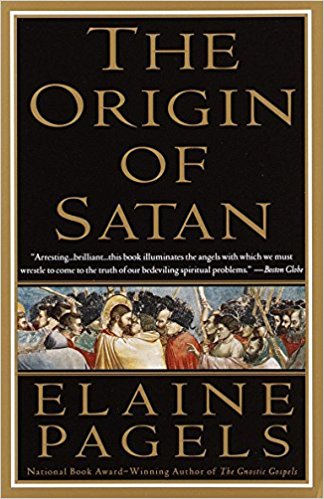
1995_*_Pagels.jpg (324 × 499 pixels, file size: 48 KB, MIME type: image/jpeg)
The Origin of Satan: How Christians Demonized Jews, Pagans, and Heretics (1995) is a book by Elaine H. Pagels.
Abstract
"From the religious historian whose The Gnostic Gospels won both the National Book Award and the National Book Critics Circle Award comes a dramatic interpretation of Satan and his role on the Christian tradition. With magisterial learning and the elan of a born storyteller, Pagels turns Satan's story into an audacious exploration of Christianity's shadow side, in which the gospel of love gives way to irrational hatreds that continue to haunt Christians and non-Christians alike."--Publisher description.
"Who is Satan in the New Testament, and what is the evil that he represents? In this groundbreaking book, Elaine Pagels, Princeton's distinguished historian of religion, traces the evolution of Satan from its origins in the Hebrew Bible, where Satan is at first merely obstructive, to the New Testament, where Satan becomes the Prince of Darkness, the bitter enemy of God and man, evil incarnate. In The Origin of Satan, Pagels shows that the four Christian gospels tell two very different stories. The first is the story of Jesus' moral genius: his lessons of love, forgiveness, and redemption. The second tells of the bitter conflict between the followers of Jesus and their fellow Jews, a conflict in which the writers of the four gospels condemned as creatures of Satan those Jews who refused to worship Jesus as the Messiah. Writing during and just after the Jewish war against Rome, the evangelists invoked Satan to portray their Jewish enemies as God's enemies too. As Pagels then shows, the church later turned this satanic indictment against its Roman enemies, declaring that pagans and infidels were also creatures of Satan, and against its own dissenters, calling them heretics and ascribing their heterodox views to satanic influences."
"Through close readings of the Gospels, Pauline letters, and early Christian writings, Pagels shows how first‑century Christians, facing conflict with Jewish authorities and the Roman Empire, reinterpreted biblical adversarial traditions to portray their opponents as agents of Satan. She demonstrates that the Gospel narratives of demonic opposition, Judas’s betrayal, and satanic temptation reflect intra‑Jewish disputes that escalated into polemical demonization as Christianity differentiated itself from Judaism. Pagels further traces how these strategies of vilification were extended to pagans, heretics, and rival Christian groups, shaping a legacy of religious conflict and exclusion. Drawing on social‑historical, literary, and theological analysis, she argues that the figure of Satan crystallized the early church’s struggle for identity, turning human adversaries into embodiments of cosmic evil. The study thus reframes Satan not as a timeless supernatural enemy but as a historically contingent symbol deployed in the service of boundary‑making, offering critical insight into the origins of Christian demonology and its enduring consequences for interreligious relations."--ChatGTP
Editions
Published in New York, NY: Random House, 1995 (#2052).
Translations
Table of contents
- The gospel of Mark and the Jewish war
- The social history of Satan : from the Hebrew Bible to the gospels
- Matthew's campaign against the Pharisees : deploying the devil
- Luke and John claim Israel's legacy : the split widens
- Satan's earthly kingdom : Christians against pagans
- The enemy within : demonizing the heretics
External links
File history
Click on a date/time to view the file as it appeared at that time.
| Date/Time | Thumbnail | Dimensions | User | Comment | |
|---|---|---|---|---|---|
| current | 01:25, 19 July 2018 | | 324 × 499 (48 KB) | Gabriele Boccaccini (talk | contribs) |
You cannot overwrite this file.
File usage
There are no pages that use this file.

- 1995
- 1990s
- Women Authorship--1990s
- Women Authorship--English
- English language--1990s
- Christian Origins Studies--1990s
- Christian Origins Studies--English
- Apocalyptic Studies--1990s
- Apocalyptic Studies--English
- Angels & Demons (subject)
- Devil (subject)
- Devil--history (subject)
- Top 1990s
- Mega Bestsellers
- International Bestsellers