File:2022 Davies.jpg
Original file (1,000 × 1,500 pixels, file size: 177 KB, MIME type: image/jpeg)
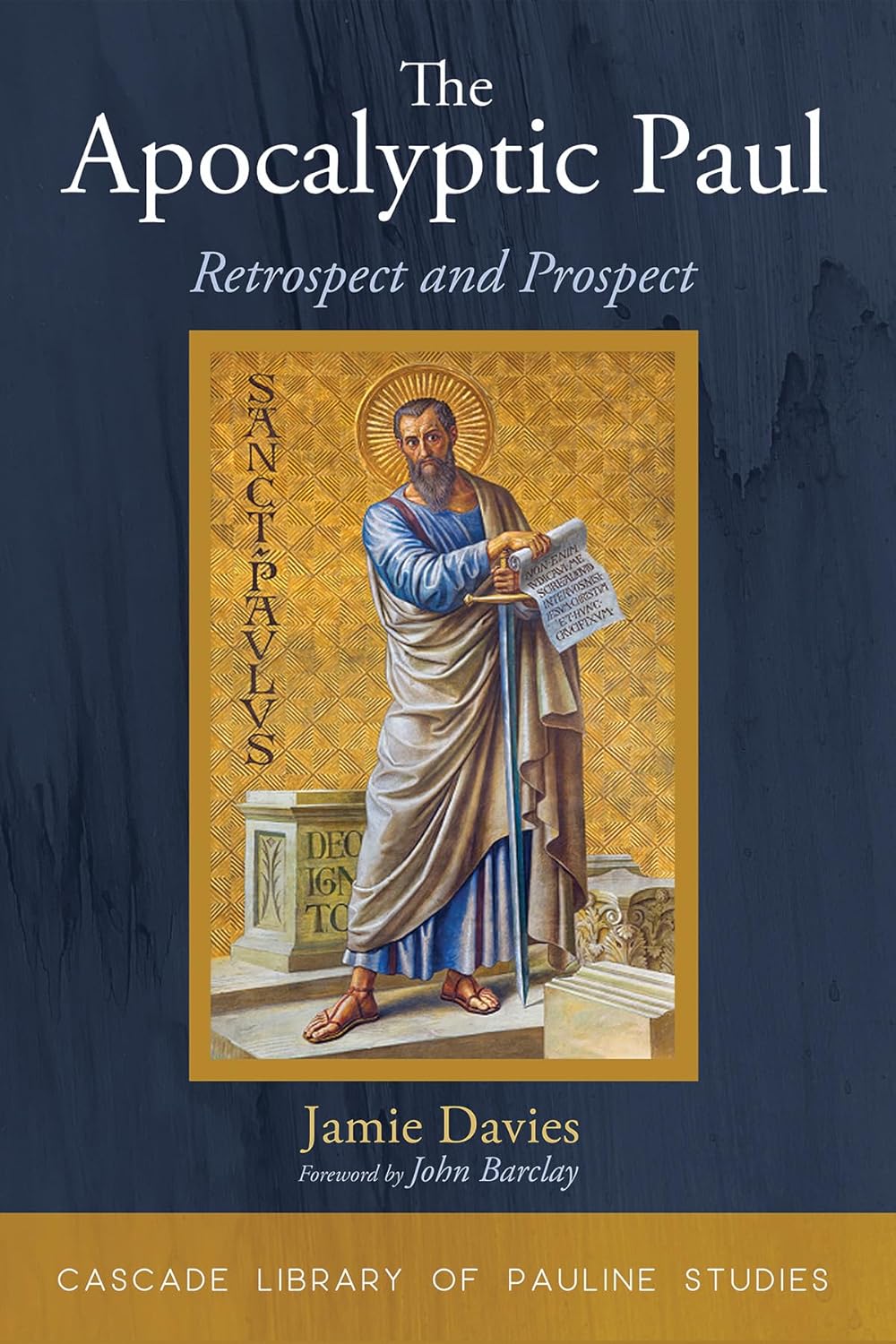
Jamie Davies, The Apocalyptic Paul: Retrospect and Prospect (Eugene, OR: Cascade, 2022).
Abstract
"The Apocalyptic Paul is rapidly becoming one of the most influential contemporary approaches to the apostle’s letters, and one which has generated its share of controversy. Critiques of the movement have come from all sides: Pauline specialists, scholars of Jewish and Christian apocalyptic literature, and systematic theologians have all raised critical questions. Meanwhile, many have found it a hard conversation to enter, not least because of the contested nature of its key terms and convictions. Non-specialists can find it difficult to sift through these arguments and to become familiar with the history of this movement, its most important contemporary voices, and its key claims. In the first part of this book, New Testament scholar Jamie Davies offers a retrospective introduction to the conversation, charting its development from the turn of the twentieth century to the present, surveying the contemporary situation. In the second part, Davies explores a more prospective account of the challenges and questions that are likely to energize discussion in the future, before offering some contributions to the apocalyptic reading of Paul through an interdisciplinary conversation between the fields of New Testament scholarship, Second Temple Jewish apocalypticism, and Christian systematic theology."--Publisher description.
"Jamie Davies’ The Apocalyptic Paul: Retrospect and Prospect offers a comprehensive survey and critical reassessment of the so‑called “apocalyptic Paul” movement, a major stream in Pauline scholarship since the work of Ernst Käsemann and J. Louis Martyn. The book is divided into two main parts ... In Part I (Retrospect), Davies traces the genealogy of apocalyptic interpretation of Paul, from its early formation in Käsemann’s post‑war theological context, through Beker’s and Martyn’s landmark contributions, to its recent articulation by scholars such as Martinus C. de Boer, Douglas Campbell, and Beverly Roberts Gaventa. He clarifies the core convictions of the movement: divine agency as primary, the invasion of the present age by God’s eschatological power, the cosmic dimension of Paul’s theology, and the reconfiguration of the human in light of God’s decisive act in Christ. Davies also highlights internal debates, including the degree of discontinuity between old and new, the relationship to covenantal nomism, and the integration (or lack thereof) of Jewish apocalyptic traditions ... In Part II (Prospect), Davies advances constructive proposals for the future of apocalyptic readings. He argues for understanding “apocalyptic” not as a fixed doctrinal system but as a hermeneutical mode that foregrounds divine agency, cosmic scope, and eschatological transformation. Drawing on interdisciplinary approaches—Second Temple Jewish studies, Pauline exegesis, and systematic theology—he proposes fresh readings of Pauline texts that balance cosmic imagery with anthropological concerns. Davies also calls for closer engagement with the diversity of Jewish apocalyptic literature (e.g., 1 Enoch, 4 Ezra) to nuance Pauline interpretation ... The volume is both a state‑of‑the‑field survey and a forward‑looking manifesto, situating apocalyptic Paul scholarship within its historical trajectory while charting directions for continued research. Davies’ work consolidates the apocalyptic Paul as a vital category in Pauline studies, while warning against reductionist dichotomies and encouraging a more integrated, historically grounded approach ... This book is now considered one of the most authoritative, up‑to‑date guide for scholars seeking to understand both the legacy and future of the apocalyptic Paul debate."--ChatGPT
Contents
About the Author
Jamie Davies is Tutor of New Testament at Trinity College, Bristol (UK). He is the author of Paul Among the Apocalypses? (2016).
External links
- [ Google Books]
File history
Click on a date/time to view the file as it appeared at that time.
| Date/Time | Thumbnail | Dimensions | User | Comment | |
|---|---|---|---|---|---|
| current | 09:02, 30 July 2025 | | 1,000 × 1,500 (177 KB) | Gabriele Boccaccini (talk | contribs) |
You cannot overwrite this file.
File usage
There are no pages that use this file.
