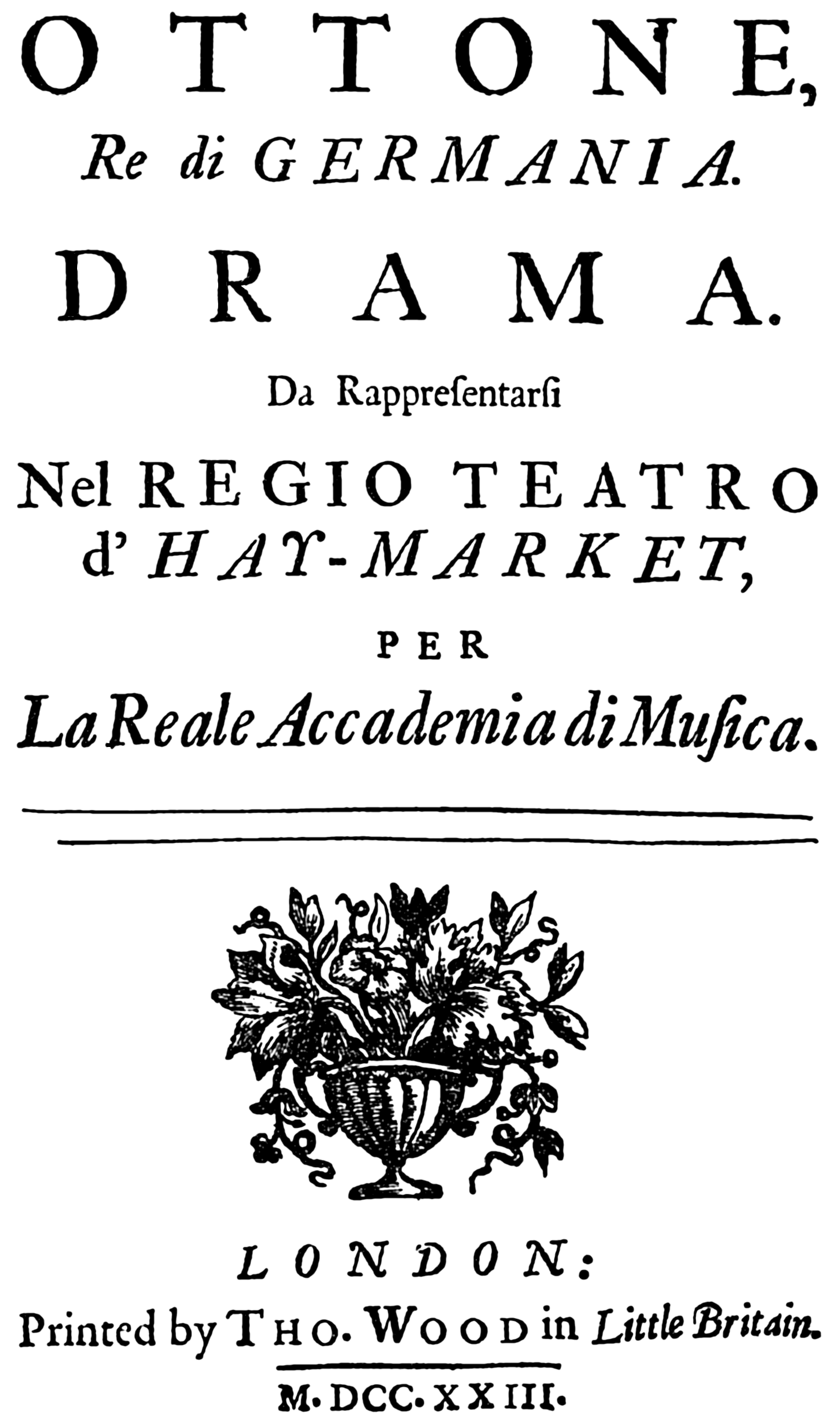
File:1723 Handel (opera).png


Original file (1,536 × 2,604 pixels, file size: 333 KB, MIME type: image/png)
Ottone, re di Germania (Handel, 1723)
- 1. The Superstars and the Window Threat at the World Premiere (1723)
The opera debuted on January 12, 1723, at the King's Theatre in Haymarket, London. It was an absolute commercial blockbuster—the value of scalped tickets soared as audiences rushed to see a legendary cast featuring the star castrato Senesino in the title role. This premiere is famously immortalized by an explosive backstage clash: when the legendary Italian soprano Francesca Cuzzoni (making her English debut as Teofane) refused to sing her opening aria, "Falsa immagine," complaining it was not virtuosic enough, an enraged Handel grabbed her by the waist and threatened to throw her out of a second-story window. She relented, and the aria became a massive success.
- 2. The Farinelli Factor and Early Revivals (1723–1734)
Ottone became one of Handel's most frequently revived works during his lifetime, receiving 36 performances across five subsequent seasons. Its most notable early revival occurred in December 1734. This production is highly historically significant as the only Handel opera performance in which the legendary castrato Farinelli ever appeared. Farinelli took on the role of the antagonist Adelberto, drawing immense crowds and cementing the opera's status as a vocal tour de force.
- 3. The Catalyst for the Global 20th-Century Handel Renaissance (1921)
After nearly two centuries of silence, Ottone secured an irreplaceable spot in music history on July 5, 1921, in Göttingen, Germany. Orchestrated by art historian Oskar Hagen, this landmark production was the very first modern revival of any Handel opera in the 20th century. Hagen heavily compressed and rearranged the score to match modern theatrical expectations, and its unexpected success launched the global Handel-Renaissance, paving the way for the modern resurrection of Giulio Cesare, Rodelinda, and the rest of Handel's operatic catalog.
4. The Modern Period Instrument Pioneering Recordings (1992–1993).
As the Historically Informed Performance (HIP) movement matured, Ottone received back-to-back definitive audio presentations that rescued its full, unaltered score from obscurity. In the early 1990s, two rival conductors captured the opera's stylistic depth: Nicholas McGegan led a dramatic production at the Göttingen Handel Festival, while Robert King and The King's Consort recorded a highly praised, fluidly lyrical interpretation featuring legendary countertenor James Bowman as Ottone. These recordings proved that the opera's musical riches extended far beyond its historical anecdotes.
- 5. The Critical Tour and Definitive Decca Recording (2014–2017).
In the 21st century, Ottone found an ideal modern champion in the English Touring Opera (ETO). Their 2014 production (later revived in 2022) featured critically acclaimed, lavish Byzantine-inspired designs and was played entirely on period instruments by the Old Street Band. This renewed interest culminated in a 2017 landmark studio recording on the Decca label, conducted by Greek baroque specialist George Petrou with the ensemble Il Pomo d'Oro and countertenor Max Emanuel Cencic in the title role, which stands today as the acoustic benchmark for the opera.
File history
Click on a date/time to view the file as it appeared at that time.
| Date/Time | Thumbnail | Dimensions | User | Comment | |
|---|---|---|---|---|---|
| current | 10:05, 1 September 2026 | | 1,536 × 2,604 (333 KB) | Gabriele Boccaccini (talk | contribs) |
You cannot overwrite this file.
File usage
The following page uses this file:
