File:1772 Barker.jpg


Original file (856 × 1,360 pixels, file size: 117 KB, MIME type: image/jpeg)
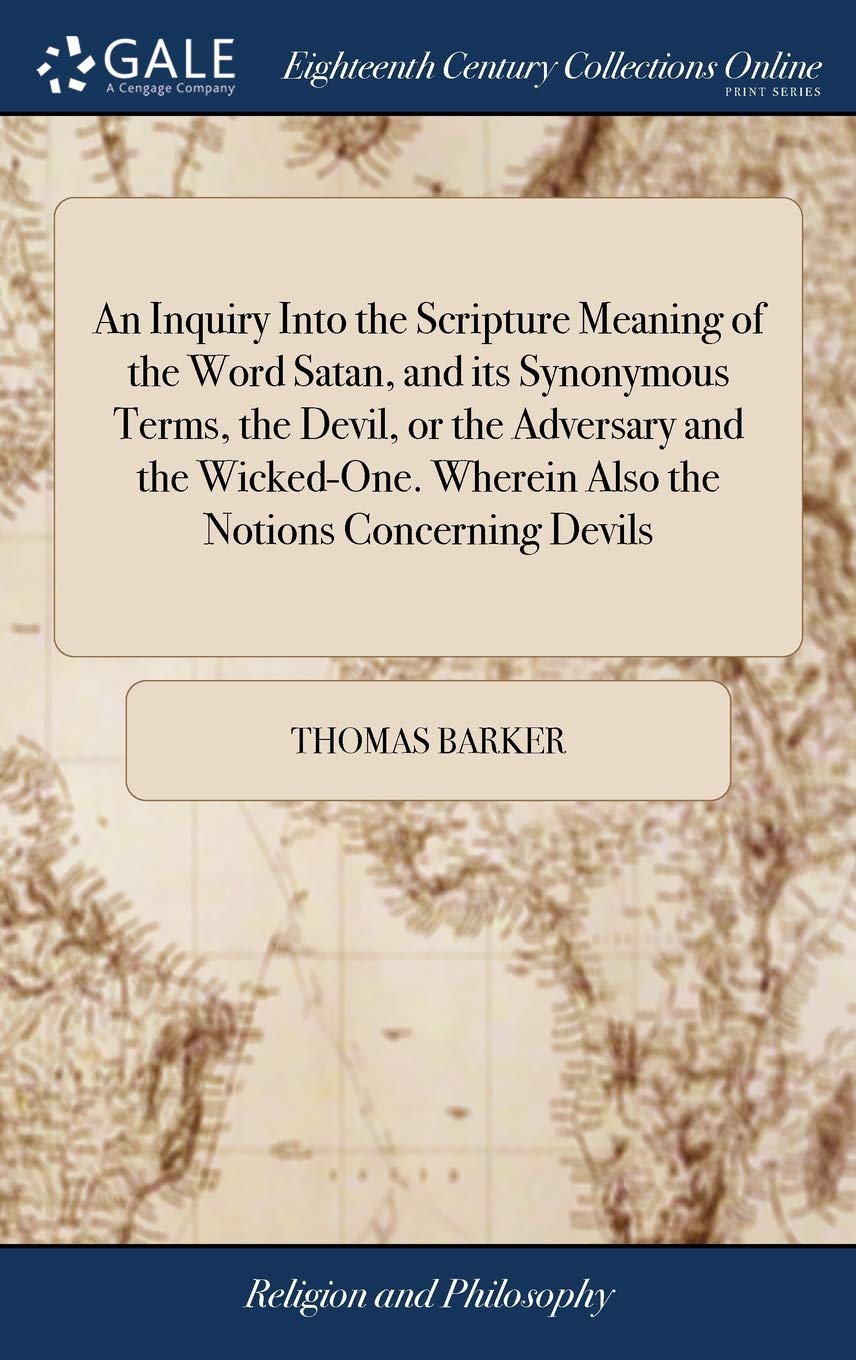
Thomas Barker, An Inquiry into the Scripture Meaning of the Word Satan, and Its Synonimous Terms, the Devil, or the Adversary, and the Wicked-One (London [England]: J. Wheble, 1772).
Abstract
"Wherein also, the notions concerning devils, or demons, are brought down to the standard of scripture ; the whole interspersed with remarks on various terms, passages, and phrases in the Old and New Testaments."
"Joseph Barker’s An Inquiry into the Scripture Meaning of the Word Satan, and Its Synonimous Terms (1772) represents a significant contribution to eighteenth‑century rationalist biblical criticism. Writing within a context shaped by Enlightenment skepticism and the rise of deistic and Socinian currents, Barker challenges traditional Christian demonology by reexamining the biblical usage of “Satan” and related terms ... The treatise employs a philological and contextual analysis of the Hebrew and Greek Scriptures, arguing that satan in the Old Testament and its New Testament counterparts seldom, if ever, denote a personal supernatural being. Instead, Barker contends, the term is most often used in the sense of an “adversary,” whether human, circumstantial, or figurative. He insists that much of Christian tradition has misread the biblical text by imposing post‑biblical notions of a fallen angelic rebel onto passages that, in their original context, refer to human opponents, prosecuting angels, or metaphorical forces of opposition ... Barker’s approach reflects the rationalist and moralizing impulses of his time: rather than affirming a cosmic Devil actively influencing the world, he interprets evil as rooted in human passion, ignorance, and moral failure. The work systematically critiques the theological necessity of a personal Satan, suggesting that such a figure is extraneous to Scripture and inconsistent with the benevolence and sovereignty of God ... Theologically, the inquiry aligns with anti‑Calvinist and anti‑traditionalist tendencies, seeking to strip Christianity of what Barker regards as superstitious accretions. At the same time, the text functions as a pastoral appeal, urging readers to take responsibility for moral evil without attributing it to external demonic compulsion ... Barker’s Inquiry thus occupies a transitional place in the history of Christian thought on the Devil: it exemplifies the Enlightenment move toward a demythologized reading of Scripture, while also anticipating later critical and liberal theological approaches that would treat Satan as a symbolic rather than ontological reality."--ChatGPT
See also:
- Hugh Farmer (1714–1787), An Essay on the Demoniacs of the New Testament: Containing an Inquiry into the Nature of Demoniac Possession, and a Supposed Power of Casting Out Demons (London, 1765) [denies the existence od demons)
- William Ashdowne, An attempt to prove that the opinion concerning the Devil, or Satan, as a Fallen Angel, and that he Tempts Men to Sin, Hath No Real Foundation in Scripture (Second Edition, enriched from a c. 1770 pamphlet, published in Canterbury in 1794)
Table of contents
External links
- [ Google Books]
File history
Click on a date/time to view the file as it appeared at that time.
| Date/Time | Thumbnail | Dimensions | User | Comment | |
|---|---|---|---|---|---|
| current | 15:47, 29 July 2025 | | 856 × 1,360 (117 KB) | Gabriele Boccaccini (talk | contribs) |
You cannot overwrite this file.
File usage
There are no pages that use this file.
