Category:De decalogo (text)
De decalogo is one of Philo's Works.
Overview
Synopsis
- Introduction
The first part of the treatise deals with some questions raised by the law-giving on Sinai. First, why was it given in the desert? Four reasons are suggested:
(a) because of the vanity and idolatry rampant in cities (2-9),
(b) because solitude promotes repentance (10-13),
(c) because it was well that laws needed for civic life should begin before the era of that life began (14),
(d) that the divine origin of the laws should be attested by the miraculous supply of food in the barren wilderness (15-17).
Secondly, observing that the Commandments given by God Himself were ten, we ask why that number, and the answer is given by a disquisition on its perfection as a number (18-31).
Thirdly, what was the nature of the voice which announced the commandments? It was not God's, for He is not a man, but an invisible land of speech created for the occasion (32-35).
Fourthly, why was the singular number "thou" used?
(a) Because it emphasizes the value of the individual soul (36-38),
(b) the personal appeal better secures obedience (39),
(c) it is a lesson to the great not to despise the humblest (40-44).
The Introduction concludes with some words on the grandeur of the scene, particularly the fire from which the voice issued (45-49).
- The Commandments
Coming to the Commandments themselves, after noting that they divide into two sets of five (50-51), we pass to the analysis is each of them.
(I) Polytheism is denounced, particularly as taking the form of worship given to the elements or heavenly bodies (52-65).
(II) Worse than this is the worship of lifeless images forbidden by the Second Commandment. Its absurdity is exposed (66-76) and with it the worse absurdity of Egyptian animal-worship (77-81).
(III) The Third Commandment is taken as forbidding principally perjury (82-91), but also reckless swearing (92-95).
(IV) The Fourth teaches us to set apart a time for philosophy as opposed to practical life (96-101), and reasons are given for the sanctity of seven and the seventh day in particular (102-105).
(V) The Fifth stands on the border-line, because parenthood assimilates man to God and to dishonor parents is to dishonor God (106-111). Children owe all to their parents, and in the duty of repaying kindness they may take a lesson from the lower animals (112-120).
(VI) The second set of five opens with the Sixth--prohibition of Adultery (121). Adultery is denounced as (a) voluptuous (122), (b) involving the sin of another (123-124), (c) destructive of family ties (125-127), (d) cruel to the children (128-131).
(VII) The Seventh forbids murder as both unnatural and sacrilegious, since man is the most sacred of God's possessions (132-134).
(VIII) Stealing is forbidden by the Eighth, because theft on the smallest scale may develop into wholesale robbery and usurpation (135-137).
(IX) The Ninth forbids false witness, as opposed in itself to truth and justice, and also in law-courts causing judges to give wrong verdicts and thus break their own oaths (138-141).
(X) The Tenth and last Commandment against "desire" gives Philo an opportunity of discoursing in Stoical terms on the four passions, pleasure, grief, fear, desire, of which the last is the deadliest (142-153).
- Conclusion
After a section summarizing the nature of the particular laws which will be placed under each commandment (154-175), the treatise ends with a concluding statement aimed to justify the absence of any penalties attached to the commandments--God who is the cause of good leaves the punishment for transgression to his subordinates (176-178).
Related categories
External links
Pages in category "De decalogo (text)"
The following 2 pages are in this category, out of 2 total.
Media in category "De decalogo (text)"
This category contains only the following file.
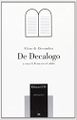 2005 Calabi.jpg 321 × 499; 14 KB
