Difference between revisions of "File:2017 Church.jpg"
| Line 1: | Line 1: | ||
[[Philip Church]], '''Hebrews and the Temple: Attitudes to the Temple in Second Temple Judaism and in Hebrews''' ([[Supplements to Novum Testamentum]], 171; Leiden: Brill, 2017). | |||
==Abstract== | |||
"In Hebrews and the Temple Philip Church argues that the silence of Hebrews concerning the Temple does not mean that the author is not interested in the Temple. He writes to encourage his readers to abandon their preoccupation with it and to follow Jesus to their eschatological goal. Following extensive discussions of attitudes to the Temple in the literature of Second Temple Judaism, Church turns to Hebrews and argues that the Temple is presented there as a symbolic foreshadowing of the eschatological dwelling of God with his people. Now that the eschatological moment has arrived with the exaltation of Christ to the right hand of God, preoccupation with the Temple and its rituals must cease"--Publisher description. | |||
==Contents== | |||
Introduction -- Part 1. Attitudes to the Temple in the literature of Second Temple Judaism. Temple affirmed : Temple symbolism in texts reflecting a positive attitude to the Temple -- Temple rejected : Temple symbolism in the Dead Sea scrolls -- Temple contested : Temple symbolism in texts reflecting dissatisfaction with the Temple -- Temple destroyed : Temple symbolism in texts responding to the fall of the Temple -- Part 2. Temple symbolism in Hebrews. The eschatological orientation of Hebrews -- The eschatological goal of the people of God : Temple symbolism in Hebrews 3:1-4:11; 11:1-13:16 -- Jesus the High Priest of the heavenly Temple : Temple symbolism in Hebrews 4:14-10:25 -- Conclusion. | |||
==External links== | |||
[[Category:2017| Church]] | |||
[[Category:English language--2010s|2017 Church]] | |||
[[Category:Second Temple Studies--2010s|2017 Church]] | |||
[[Category:Second Temple Studies--English|2017 Church]] | |||
[[Category:New Testament Studies--2010s|2017 Church]] | |||
[[Category:New Testament Studies--English|2017 Church]] | |||
[[Category:Temple (subject)|2017 Church]] | |||
[[Category:Hebrews (text)|2017 Church]] | |||


Latest revision as of 14:44, 23 September 2025
Philip Church, Hebrews and the Temple: Attitudes to the Temple in Second Temple Judaism and in Hebrews (Supplements to Novum Testamentum, 171; Leiden: Brill, 2017).
Abstract
"In Hebrews and the Temple Philip Church argues that the silence of Hebrews concerning the Temple does not mean that the author is not interested in the Temple. He writes to encourage his readers to abandon their preoccupation with it and to follow Jesus to their eschatological goal. Following extensive discussions of attitudes to the Temple in the literature of Second Temple Judaism, Church turns to Hebrews and argues that the Temple is presented there as a symbolic foreshadowing of the eschatological dwelling of God with his people. Now that the eschatological moment has arrived with the exaltation of Christ to the right hand of God, preoccupation with the Temple and its rituals must cease"--Publisher description.
Contents
Introduction -- Part 1. Attitudes to the Temple in the literature of Second Temple Judaism. Temple affirmed : Temple symbolism in texts reflecting a positive attitude to the Temple -- Temple rejected : Temple symbolism in the Dead Sea scrolls -- Temple contested : Temple symbolism in texts reflecting dissatisfaction with the Temple -- Temple destroyed : Temple symbolism in texts responding to the fall of the Temple -- Part 2. Temple symbolism in Hebrews. The eschatological orientation of Hebrews -- The eschatological goal of the people of God : Temple symbolism in Hebrews 3:1-4:11; 11:1-13:16 -- Jesus the High Priest of the heavenly Temple : Temple symbolism in Hebrews 4:14-10:25 -- Conclusion.
External links
File history
Click on a date/time to view the file as it appeared at that time.
| Date/Time | Thumbnail | Dimensions | User | Comment | |
|---|---|---|---|---|---|
| current | 11:06, 17 October 2019 | 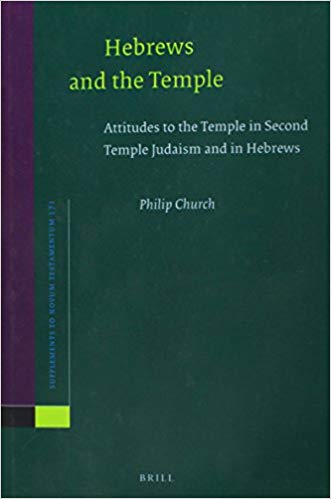 | 331 × 499 (16 KB) | Gabriele Boccaccini (talk | contribs) |
You cannot overwrite this file.
File usage
There are no pages that use this file.
