Difference between revisions of "Masada"
(Redirected page to Category:Masada (subject)) |
|||
| Line 1: | Line 1: | ||
*SCHOLARLY AND FICTIONAL WORKS: see [[:Category:Masada (subject)]] | |||
*ANCIENT SOURCES: see [[Masada (sources)]] | |||
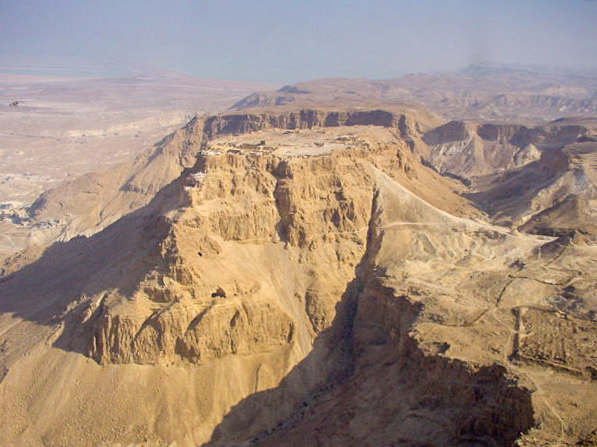
[http://upload.wikimedia.org/wikipedia/commons/3/39/Vista_general_de_Masada.jpg Masada] was a Herodian fortress. | |||
==History== | |||
Between 37 and 31 BCE, [[Herod the Great]] built the fortress for himself, as a refuge in the event of a revolt. The fortress included the royal palace. | |||
In the first year of the [[:Category:Jewish War (subject)|Jewish War]], Masada became the stronghold of the [[Sicarii]] led by [[Simon bar Giora]]. When Simon moved to Jerusalem in 69 CE, the command of the fortress was taken by [[Eleazar ben Yair]]. | |||
In 72-73, after the fall of [[Jerusalem]], Masada also was besieged by the Romans, led by [[Lucius Flavius Silva]]. The Roman legion X Fretensis surrounded the fortress and built a ramp against its western walls. According to Josephus, in anticipation of the final assault, [[Eleazar ben Yair]] and the Jewish occupants of Masada committed mass suicide, preferring death to surrender. | |||
==Masada in ancient sources== | |||
The sole literary source of information about the site of Masada are the writings of Flavius Josephus. | |||
See [[Masada (sources)]] | |||
==Masada in Scholarship== | |||
The site of Masada was identified in 1842 and extensively excavated between 1963 and 1965 by [[Yigael Yadin]]. The remoteness of the place had left the site virtually untouched. | |||
See [[Masada: An Epic Story (2009 Eshel), book (English ed.)]] | |||
==Masada in Fiction== | |||
In 1927 the poem Metzadah by [[Isaac Lamdan]] transformed Masada from a symbol of destruction into an emblem of rebirth, renewal, and reconstruction. The line “Again Masada shall not fall” became a motto of the Zionist movement and made the poem Metzadah the most influential literary work for a whole generation of Jewish Israelis. Especially in the aftermath of the establishment of the State of Israel, the myth of Masada has generated a flow of fictional works. | |||
In the 1950s, units of the Israeli army initiated the practice of holding their swearing-in ceremony on top of Masada. | |||
See [[The Masada Myth (1995 Ben-Yehuda), book]] | |||
==Related categories== | |||
*[[Herodian Fortresses]] | |||
*[[:Category:Herod the Great (subject)|Herod the Great (subject)]] | |||
*[[:Category:Jewish War (subject)|Jewish War (subject)]] | |||
==Refrences== | |||
*'''Fortresses and Palaces: Masada ''' / [[Adam Marshak]] and [[Daniel C. Harlow]] / In: [[The Eerdmans Dictionary of Early Judaism (2010 Collins / Harlow), edited volume]], 651-652 | |||
*'''Masada ''' / [[Kenneth Atkinson]] / In: [[The Eerdmans Dictionary of Early Judaism (2010 Collins / Harlow), edited volume]], 919-922 | |||
==External links== | |||
*[http://en.wikipedia.org/wiki/Masada Wikipedia] / [http://www.bibleplaces.com/masada.htm BiblePlaces.com] | |||
====Pictures from the web==== | |||
*[http://upload.wikimedia.org/wikipedia/commons/thumb/2/25/Termas_en_Masada.JPG/450px-Termas_en_Masada.JPG Thermal Baths] (from Wikipedia) | |||
*[http://upload.wikimedia.org/wikipedia/commons/thumb/5/52/Masada04.JPG/800px-Masada04.JPG Palace] (from Wikimedia Commons) | |||
*[http://upload.wikimedia.org/wikipedia/commons/thumb/4/4c/Masada_Roman_Ruins_by_David_Shankbone.jpg/800px-Masada_Roman_Ruins_by_David_Shankbone.jpg Remnants of one of several legionary camps at Masada] (from Wikipedia) | |||
*[http://upload.wikimedia.org/wikipedia/commons/thumb/4/4d/Masada_Roman_ramp200704.JPG/800px-Masada_Roman_ramp200704.JPG Roman Siege Rampe] (from Wikimedia) | |||
[[Category:Places]] | |||
Revision as of 06:38, 26 September 2011
- SCHOLARLY AND FICTIONAL WORKS: see Category:Masada (subject)
- ANCIENT SOURCES: see Masada (sources)
Masada was a Herodian fortress.
History
Between 37 and 31 BCE, Herod the Great built the fortress for himself, as a refuge in the event of a revolt. The fortress included the royal palace.
In the first year of the Jewish War, Masada became the stronghold of the Sicarii led by Simon bar Giora. When Simon moved to Jerusalem in 69 CE, the command of the fortress was taken by Eleazar ben Yair.
In 72-73, after the fall of Jerusalem, Masada also was besieged by the Romans, led by Lucius Flavius Silva. The Roman legion X Fretensis surrounded the fortress and built a ramp against its western walls. According to Josephus, in anticipation of the final assault, Eleazar ben Yair and the Jewish occupants of Masada committed mass suicide, preferring death to surrender.
Masada in ancient sources
The sole literary source of information about the site of Masada are the writings of Flavius Josephus.
See Masada (sources)
Masada in Scholarship
The site of Masada was identified in 1842 and extensively excavated between 1963 and 1965 by Yigael Yadin. The remoteness of the place had left the site virtually untouched.
See Masada: An Epic Story (2009 Eshel), book (English ed.)
Masada in Fiction
In 1927 the poem Metzadah by Isaac Lamdan transformed Masada from a symbol of destruction into an emblem of rebirth, renewal, and reconstruction. The line “Again Masada shall not fall” became a motto of the Zionist movement and made the poem Metzadah the most influential literary work for a whole generation of Jewish Israelis. Especially in the aftermath of the establishment of the State of Israel, the myth of Masada has generated a flow of fictional works.
In the 1950s, units of the Israeli army initiated the practice of holding their swearing-in ceremony on top of Masada.
See The Masada Myth (1995 Ben-Yehuda), book
Related categories
Refrences
- Fortresses and Palaces: Masada / Adam Marshak and Daniel C. Harlow / In: The Eerdmans Dictionary of Early Judaism (2010 Collins / Harlow), edited volume, 651-652
- Masada / Kenneth Atkinson / In: The Eerdmans Dictionary of Early Judaism (2010 Collins / Harlow), edited volume, 919-922
External links
Pictures from the web
- Thermal Baths (from Wikipedia)
- Palace (from Wikimedia Commons)


- Remnants of one of several legionary camps at Masada (from Wikipedia)

- Roman Siege Rampe (from Wikimedia)
