Difference between revisions of "File:1670 * Spinoza.jpg"
m (Gabriele Boccaccini moved page File:1670 Spinoza.jpg to File:1670 * Spinoza.jpg without leaving a redirect) |
|||
| Line 1: | Line 1: | ||
[[File:1670b Spinoza.jpg|thumb|150px]] | |||
[[File:1670c Spinoza.jpg|thumb|150px]] | |||
''' Tractatus Theologico-Politicus ''' <Latin> / ''Theological-Political Treatise'' (1670) is a book by [[Baruch Spinoza]]. | |||
==Abstract== | |||
"Spinoza's Theological-Political Treatise (1670) is one of the most important philosophical works of the early modern period. In it Spinoza discusses at length the historical circumstances of the composition and transmission of the Bible, demonstrating the fallibility of both its authors and its interpreters. He argues that free enquiry is not only consistent with the security and prosperity of a state but actually essential to them, and that such freedom flourishes best in a democratic and republican state in which individuals are left free while religious organizations are subordinated to the secular power. His Treatise has profoundly influenced the subsequent history of political thought, Enlightenment 'clandestine' or radical philosophy, Bible hermeneutics, and textual criticism more generally. It is presented here in a translation of great clarity and accuracy by Michael Silverthorne and Jonathan Israel, with a substantial historical and philosophical introduction by Jonathan Israel."--Publisher description. | |||
Jesus' morality is presented as superior to that of Moses. Jesus is seen as the bearer of a non-political, non-eschatological, rational message that does not need any foundation in the supernatural. This interpretation would have a profound impact in the subsequent research on the Historical Jesus. | |||
==Editions== | |||
Published anonymously in [[Hamburg, Germany]]: 1670. | |||
==Contents== | |||
* Preface | |||
Part I | |||
* 1. Of Prophecy | |||
* 2. Of Prophets | |||
* 3. Of the Vocation of the Hebrews, and whether the Gift of Prophecy was peculiar to them | |||
* 4. Of the Divine Law | |||
* 5. Of the Ceremonial Law | |||
Part II | |||
* 6. Of Miracles | |||
* 7. Of the Interpretation of Scripture | |||
* 8. Of the authorship of the Pentateuch, and the other historical books of the Hebrew Bible | |||
* 9. Other questions about these books | |||
* 10. An Examination of the remaining books of the Old Testament according to the preceding method | |||
Part III | |||
* 11. An Inquiry whether the Apostles wrote their Epistles as Apostles and Prophets, or merely as Teachers, and an Explanation of what is meant by an Apostle | |||
* 12. Of the true Original of the Divine Law, and wherefore Scripture is called Sacred, and the Word of G-D. How that, in so far as it contains the Word of G-D, it has come down to us uncorrupted | |||
* 13. It is shown, that Scripture teaches only very Simple Doctrines, such as suffice for right conduct | |||
* 14. Definitions of Faith, the True Faith, and the Foundations of Faith, which is once for all separated from Philosophy | |||
* 15. Theology is shown not to be subservient to Reason, nor Reason to Theology: a Definition of the reason which enables us to accept the Authority of the Bible | |||
Part IV | |||
* 16. Of the Foundations of a State; of the Natural and Civil Rights of Individuals; and of the Rights of the Sovereign Power | |||
* 17. It is shown, that no one can or need transfer all his Rights to the Sovereign Power. Of the Hebrew Republic, as it was during the lifetime of Moses, and after his death till the foundation of the Monarchy; and of its Excellence. Lastly, of the Causes why the Theocratic Republic fell, and why it could hardly have continued without Dissension | |||
* 18. From the Commonwealth of the Hebrews and their History certain Lessons are deduced | |||
* 19. It is shown that the Right over Matters Spiritual lies wholly with the Sovereign, and that the Outward Forms of Religion should be in accordance with Public Peace, if we would worship (OBEY G-D) aright | |||
==External links== | |||
*[http://en.wikipedia.org/wiki/Tractatus_Theologico-Politicus Wikipedia.en] -- [https://it.wikipedia.org/wiki/Trattato_teologico-politico WIkipedia.it] | |||
[[Category:1670| Spinoza]] | |||
[[Category:Jewish Authorship--1600s|1670 Spinoza]] | |||
[[Category:Jewish Authorship--Latin|1670 Spinoza]] | |||
[[Category:Latin language--1600s|1670 Spinoza]] | |||
[[Category:Made in the 1670s| 1670 Spinoza]] | |||
[[Category:Second Temple Studies--1600s|1670 Spinoza]] | |||
[[Category:Second Temple Studies--Latin|1670 Spinoza]] | |||
[[Category:Bible Studies--1600s|1670 Spinoza]] | |||
[[Category:Bible Studies--Latin|1670 Spinoza]] | |||
[[Category:Historical Jesus Studies--1600s|1670 Spinoza]] | |||
[[Category:Historical Jesus Studies--Latin|1670 Spinoza]] | |||
[[Category:Biblical Criticism (subject)|1670 Spinoza]] | |||
[[Category:Criticism (subject)|1670 Spinoza]] | |||
[[Category:Jewish views of Jesus (subject)|1670 Spinoza]] | |||
[[Category:Top 1600s|1670 Spinoza]] | |||
Latest revision as of 07:21, 16 August 2023


Tractatus Theologico-Politicus <Latin> / Theological-Political Treatise (1670) is a book by Baruch Spinoza.
Abstract
"Spinoza's Theological-Political Treatise (1670) is one of the most important philosophical works of the early modern period. In it Spinoza discusses at length the historical circumstances of the composition and transmission of the Bible, demonstrating the fallibility of both its authors and its interpreters. He argues that free enquiry is not only consistent with the security and prosperity of a state but actually essential to them, and that such freedom flourishes best in a democratic and republican state in which individuals are left free while religious organizations are subordinated to the secular power. His Treatise has profoundly influenced the subsequent history of political thought, Enlightenment 'clandestine' or radical philosophy, Bible hermeneutics, and textual criticism more generally. It is presented here in a translation of great clarity and accuracy by Michael Silverthorne and Jonathan Israel, with a substantial historical and philosophical introduction by Jonathan Israel."--Publisher description.
Jesus' morality is presented as superior to that of Moses. Jesus is seen as the bearer of a non-political, non-eschatological, rational message that does not need any foundation in the supernatural. This interpretation would have a profound impact in the subsequent research on the Historical Jesus.
Editions
Published anonymously in Hamburg, Germany: 1670.
Contents
- Preface
Part I
- 1. Of Prophecy
- 2. Of Prophets
- 3. Of the Vocation of the Hebrews, and whether the Gift of Prophecy was peculiar to them
- 4. Of the Divine Law
- 5. Of the Ceremonial Law
Part II
- 6. Of Miracles
- 7. Of the Interpretation of Scripture
- 8. Of the authorship of the Pentateuch, and the other historical books of the Hebrew Bible
- 9. Other questions about these books
- 10. An Examination of the remaining books of the Old Testament according to the preceding method
Part III
- 11. An Inquiry whether the Apostles wrote their Epistles as Apostles and Prophets, or merely as Teachers, and an Explanation of what is meant by an Apostle
- 12. Of the true Original of the Divine Law, and wherefore Scripture is called Sacred, and the Word of G-D. How that, in so far as it contains the Word of G-D, it has come down to us uncorrupted
- 13. It is shown, that Scripture teaches only very Simple Doctrines, such as suffice for right conduct
- 14. Definitions of Faith, the True Faith, and the Foundations of Faith, which is once for all separated from Philosophy
- 15. Theology is shown not to be subservient to Reason, nor Reason to Theology: a Definition of the reason which enables us to accept the Authority of the Bible
Part IV
- 16. Of the Foundations of a State; of the Natural and Civil Rights of Individuals; and of the Rights of the Sovereign Power
- 17. It is shown, that no one can or need transfer all his Rights to the Sovereign Power. Of the Hebrew Republic, as it was during the lifetime of Moses, and after his death till the foundation of the Monarchy; and of its Excellence. Lastly, of the Causes why the Theocratic Republic fell, and why it could hardly have continued without Dissension
- 18. From the Commonwealth of the Hebrews and their History certain Lessons are deduced
- 19. It is shown that the Right over Matters Spiritual lies wholly with the Sovereign, and that the Outward Forms of Religion should be in accordance with Public Peace, if we would worship (OBEY G-D) aright
External links
File history
Click on a date/time to view the file as it appeared at that time.
| Date/Time | Thumbnail | Dimensions | User | Comment | |
|---|---|---|---|---|---|
| current | 02:04, 13 August 2018 | 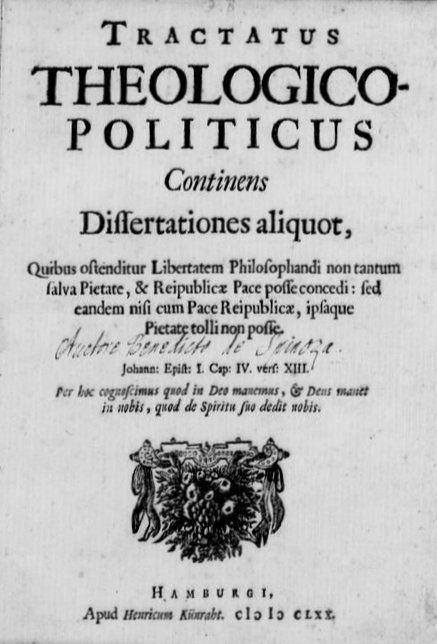 | 437 × 644 (54 KB) | Gabriele Boccaccini (talk | contribs) |
You cannot overwrite this file.
File usage
There are no pages that use this file.

- 1670
- Jewish Authorship--1600s
- Jewish Authorship--Latin
- Latin language--1600s
- Made in the 1670s
- Second Temple Studies--1600s
- Second Temple Studies--Latin
- Bible Studies--1600s
- Bible Studies--Latin
- Historical Jesus Studies--1600s
- Historical Jesus Studies--Latin
- Biblical Criticism (subject)
- Criticism (subject)
- Jewish views of Jesus (subject)
- Top 1600s