File:2024 Leuchter.jpg

Original file (400 × 608 pixels, file size: 230 KB, MIME type: image/jpeg)
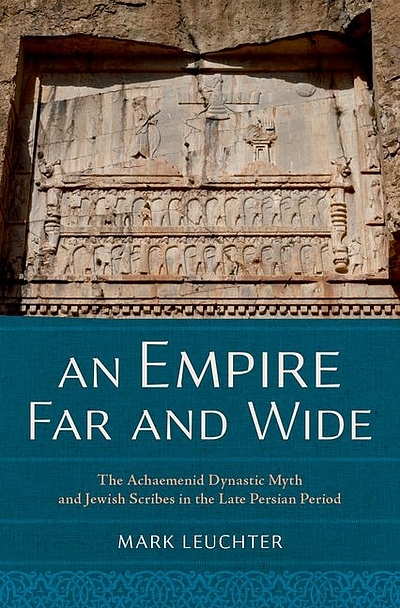
{en} Mark Leuchter. An empire far and wide: The Achaemenid dynastic myth and Jewish scribes in the late Persian period (New York, NY : Oxford University Press, 2024).
Abstract
"The Persian period (539-332 BCE) sits somewhat awkwardly within the study of Second temple Judaism. Amidst a myriad of issues and debates, the approach to the Persian period if fundamentally complicated by the difficulty in labeling communities - whether or not the communities in the province of Yehud, in Egypt, or in the eastern Diaspora can even be called 'Jewish,' a label denoting a type of ethnic and religious symbiosis that some scholas are hesitant to identify any time before the mid-second century BC. This uncertain position of the Persian Period in Jewish memory is nothing new-in fact, it can be traced back to nearly two thousand years. yet it can lead contemporary scholars to exercise too much caution when dating, analyzing, and discussing ancient scribal texts. Utilizing recent tools to examine scribal methods, Mark Leuchter takes a definitive approach. An Empire Far and Wide focuses on a careful selection of literary test cases to better understand how Jewish scribes in Persian Yehud interacted with a feature of Persian imperialism that has not received adequate attention: the dynastic mythology of the Achaemenid rulers and the way it shaped emerging Jewish identity in the Persian period. Leuchter works from the determination that we can indeed apply the terms 'Jewish' and 'Judaism' to certain Persian period communities with certain caveats. This book illuminates the fact that the Persian period is hardly a 'dark age' of study - it reveals important dimensions of Jewish culture of the era. The textual record of the learned Yehudite Jewish scribal caste of the Persian period provides us with monumental insight into a larger intellectual history - one shaped by centuries of imperialism extending back, and forward, in time." -- "Contemporary scholarship into the Jewish literature of the Persian period (538-332 BCE) has encountered theoretical and methodological difficulties regarding issues of dating sources and identifying the extent of Persia's imperial influence on Jewish identity in the era. Many scholars are even hesitant to speak of Jewishness or Judaism as existing in this period at all. A reconsideration of factors and new approaches to evidence culled from cognitive science, postcolonial research, and anthropological models for communal identity formation provides new vistas for examining the relationship between Persian imperial ideology - and in particular, the dynastic mythology of the Achaemenid rulers - in the shaping of communal identity fostered among the ranks of Jewish scribes of the era. By surveying the literary products of the Jewish scribes behind works such as the Pentateuch, Ezra-Nehemiah, Chronicles, The Book of the Twelve, and the narrative of 1 Enoch 6-11 (the earliest unit in the Book of Watchers, 1 Enoch 1-36) new avenues of inquiry may be elucidated regarding the influence of Persian imperialism on the development of scribal ideologies and assumptions among the literati of Yehud in the mid to late 4th century BCE."--
Contents
The Achaemenid dynastic myth -- The priestly scribes of Elephantine and Jerusalem in the fifth century BCE -- Accommodating empire : the mythologizing of Ezra's mission -- Negotiating empire : the Levites and the Book of the Twelve -- Repudiating empire : the Shemihazah/Asael narrative (1 Enoch 6-11).
External links
- [ Google Books]
File history
Click on a date/time to view the file as it appeared at that time.
| Date/Time | Thumbnail | Dimensions | User | Comment | |
|---|---|---|---|---|---|
| current | 15:12, 23 September 2025 | | 400 × 608 (230 KB) | Gabriele Boccaccini (talk | contribs) |
You cannot overwrite this file.
File usage
There are no pages that use this file.
