File:2011 DeLaTorre, Hernández.jpg
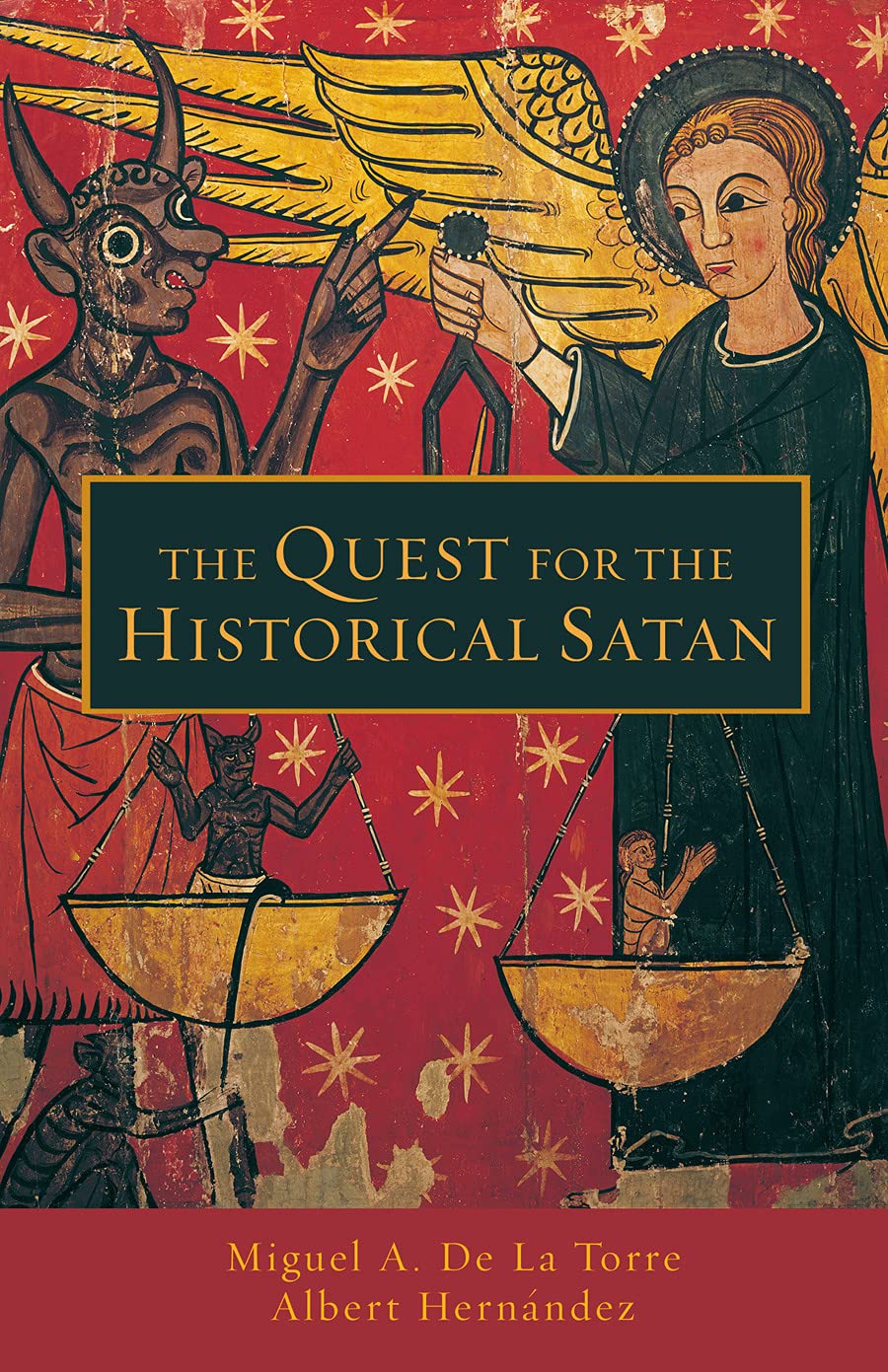
Original file (900 × 1,391 pixels, file size: 288 KB, MIME type: image/jpeg)
Miguel A. De La Torre and Albert Hernández, The Quest for the Historical Satan (Minneapolis, MN: Fortress Press, 2011).
Abstract
"The figure of Satan has for centuries embodied or incarnated absolute evil. Existing alongside more intellectualist interpretations of evil, Satan has figured largely in Christian practices, devotions, popular notions of the afterlife, and fears of retribution in the beyond. Satan remains an influential reality today in many Christian traditions and in popular culture. But how should Satan be understood today? This volume probes the murky origins of the satanic legends and beliefs back to their pre-Christian roots in the Middle East. In it the authors unearth the Satan's roots in Egyptian and Babylonian understandings of evil. They also show, however, that the ancient Satan has some characteristics we would hardly recognize, especially his appearance in most ancient cultures and survival in many traditional religions as the 'trickster' figure. While a minor tradition in historic Christianity, the authors argue, seeing Satan as trickster is historically accurate and holds real promise for Christian rethinking in 'theology, philosophy, and practice of evil' and how it can be dealt with. This is a study that helps the reader reframe basic elements of our worldview of good and evil."--Publisher description.
"Miguel A. De La Torre and Albert Hernández’s The Quest for the Historical Satan (2011) offers a critical reconstruction of the origins and development of the Satan figure within biblical, historical, and cultural contexts, combining historical‑critical exegesis with social‑ethical reflection. The authors argue that Satan was not an original component of Israelite religion but emerged gradually under the pressures of exile, imperial domination, and apocalyptic expectation, eventually becoming a fully personified adversary in Second Temple Judaism and early Christianity. Through close examination of Hebrew Bible texts, intertestamental literature, and the New Testament, the study traces the transformation of the adversarial role (ha‑satan) into a cosmic opponent of God. The book situates this development within broader Mediterranean religious currents, including Zoroastrian dualism and Greco‑Roman demonology, while also highlighting the socio‑political conditions—oppression, injustice, and the struggle for identity—that made belief in an ultimate enemy both compelling and functional for marginalized communities. Beyond historical description, De La Torre and Hernández engage liberationist hermeneutics, critiquing the ways in which the doctrine of Satan has historically been used to justify persecution, scapegoating, and violence, especially against vulnerable groups. They conclude that understanding the historical construction of Satan can free contemporary readers to resist oppressive uses of the symbol while still grappling with the enduring human reality of evil. The work thus contributes both to academic biblical scholarship and to ethical discourse, bridging historical analysis and constructive theology."--ChatGTP
Contents
Introduction: Desperately seeking Satan -- Satan in the Modern World. Satan goes to Hollywood -- Satan among Satanists -- Satan among Fundamentalists -- Satan among Catholics -- Satan and the Left Behind series -- Satan among Liberals -- Satan and ethical thought -- The Birth of Satan : a textual history. Before Satan's conception -- Satan's conception : the Hebrew bible -- Satan's childhood : Babylonian captivity and Persian influence -- Satan's adolescence : the Apocrypha and Pseudepigrapha -- Satan's early adulthood -- Clearing through the muddle -- Ethical concerns -- Satan through the ages. From Hellenistic syncretism to Christian exclusivity -- Satan's army versus the sword of the spirit -- Jesus saves! -- Wrestling with tricksters or demons? A case study -- Satan matures in early Christian discourse -- Saint Augustine and the problem of evil -- Satan Comes of Age. Greco-Roman cults and magicians -- The collapse of an empire -- Fear and evil in the early medieval imagination -- Evil characters in medieval Arthurian literature -- Satan's role in destruction and the coming of the anti-Christ -- Satan in Dante's Inferno -- Medieval witches -- The colonized other -- The devil made me do it. Satan's death -- The modern myth of Dr. Faustus -- Satan's resurrection -- Satan reimagined from a liberative perspective -- Satan as trickster? -- The ethics of a Christian trickster.
External links
- [ Google Books]
File history
Click on a date/time to view the file as it appeared at that time.
| Date/Time | Thumbnail | Dimensions | User | Comment | |
|---|---|---|---|---|---|
| current | 12:42, 28 July 2025 | | 900 × 1,391 (288 KB) | Gabriele Boccaccini (talk | contribs) |
You cannot overwrite this file.
File usage
There are no pages that use this file.
