File:1984 Russell JB.jpg
Original file (907 × 1,360 pixels, file size: 224 KB, MIME type: image/jpeg)
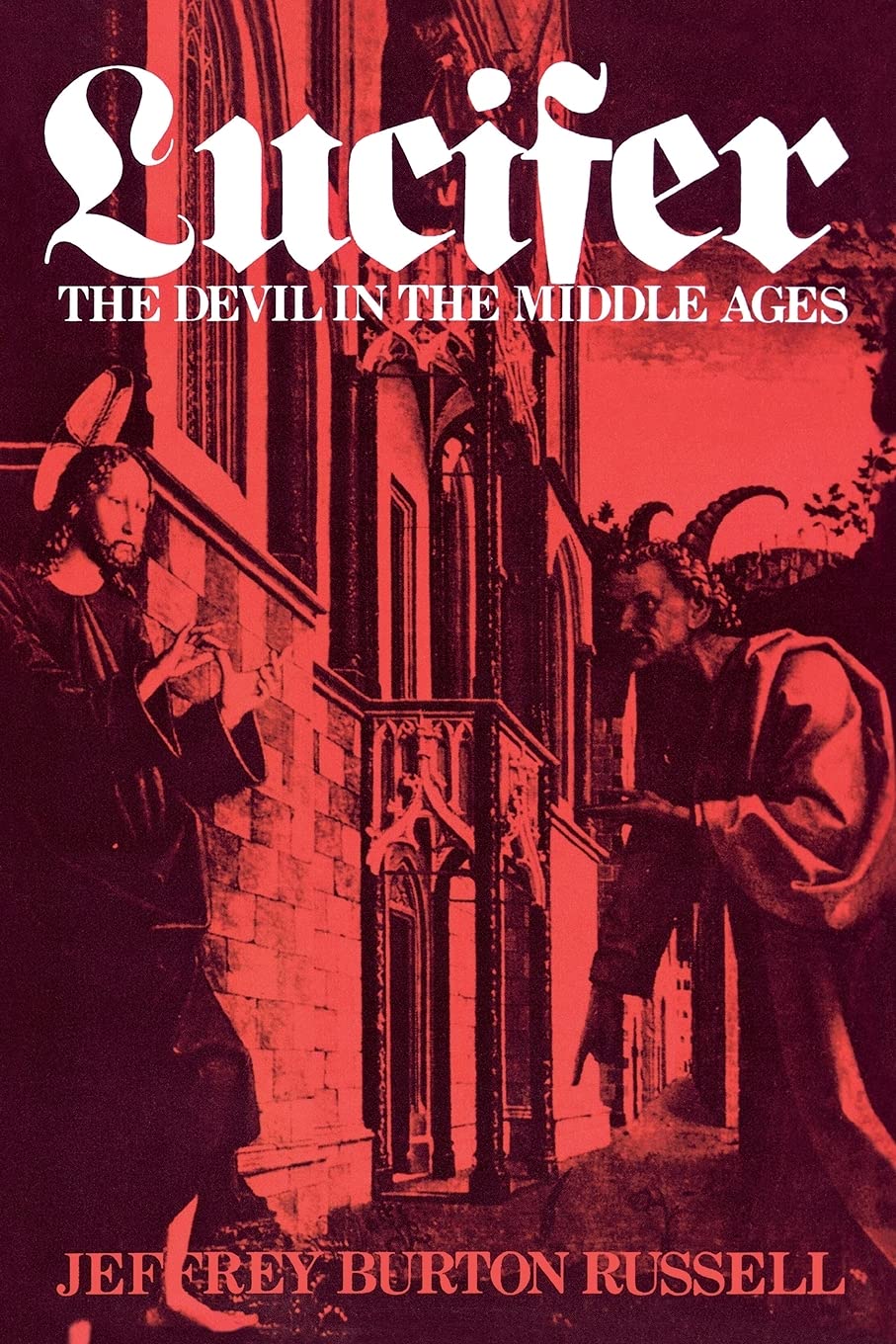
Jeffrey Burton Russell, Lucifer, the Devil in the Middle Ages (Ithaca, NY: Cornell University Press, 1984).
Abstract
"Describes the medieval concept of the devil, discusses witchcraft and devil folklore, and examines the depiction of evil in art and literature of the period."--Publisher
"This major contribution to the history of the Middle Ages and to the history of religion will enlighten scholars and students alike and will appeal to anyone concerned with the problem of evil in our world ... Evil is an intrinsically fascinating topic. In Lucifer, Jeffrey Burton Russell continues his compelling study of the personification of evil in the figure of the Devil. The previous two volumes in this remarkable tertalogy—The Devil and Satan—trace the history of the concept of the devil comparatively as it emerged in diverse cultures and followed its development in Western thought from the ancient Hebrew religion through the first five centuries of the Christian era. The present volume charts the evolution of the concept of the devil from the fifth century through the fifteenth ... Drawing on an impressive array of sources from popular religion, art, literature, and drama, as well as from scholastic philosophy, mystical theology, homiletics, and hagiography, Russell provides a detailed treatment of Christian diabology in the Middle Ages. Although he focuses primarily on Western Christian thought, Russell also includes, for the sake of comparison, material on the concept of the devil in Greek Orthodoxy during the Byzantine period as well as in Muslim thought. Russell recounts how the Middle Ages saw a refinement in detail rather than a radical alteration of diabological theory. He shows that the medieval concept of the devil, fundamentally unchanged over the course of the centuries, eventually gave rise to the unyielding beliefs that resulted in the horrifying cruelties of the witch-hunting craze in the 1500s and 1600s."--Publisher
"Jeffrey Burton Russell’s Lucifer: The Devil in the Middle Ages, the third installment in his influential multi‑volume study of the Christian devil, investigates the evolution of diabology from the early Middle Ages through the late medieval period. Russell demonstrates that, despite cultural diversity and theological debate, the Western concept of Lucifer retained a remarkable continuity of form and function between the 5th and 15th centuries. Drawing upon theology, biblical exegesis, scholastic philosophy, folklore, hagiography, homiletics, visual art, and vernacular literature, he reconstructs both elite and popular perceptions of the devil. Comparative attention is also given to Byzantine Orthodox and Islamic understandings of demonic evil, highlighting both parallels and divergences with the Latin West.
Rather than positing dramatic innovations, Russell argues for a steady refinement and elaboration of the devil’s image, culminating in a fully systematized demonology that underpinned late medieval fears and ultimately set the stage for the early modern witch‑hunts. The work is structured thematically, addressing the “life” and attributes of Lucifer, the devil in Eastern Christianity and Islam, folkloric and artistic depictions, scholastic interpretations, and mystical and nominalist perspectives, concluding with a theological reflection on the persistence and necessity of belief in real evil.
By integrating intellectual, cultural, and comparative religious history, Russell establishes the medieval period as a decisive phase in the shaping of the Western imagination of the devil, underscoring the enduring role of Lucifer in Christian thought and the dangers inherent in dismissing diabology as mere superstition."--ChatGPT
Reviews
"An attractively written survey of the way the devil appears in art, literature and treatise, during the medieval period, with many signs of an engaging sense of personal commitment to the subject, and an attempt to show its contemporary relevance."―John O. Ward ― Journal of Religious History
Contents
The life of Lucifer -- The Devil in Byzantium -- The Muslim Devil -- Folklore -- Early medieval diabology -- Lucifer in early medieval art and literature -- The Devil and the scholars -- Lucifer in high medieval art and literature -- Lucifer on the stage -- Nominalists, mystics, and witches -- The existence of the Devil.
File history
Click on a date/time to view the file as it appeared at that time.
| Date/Time | Thumbnail | Dimensions | User | Comment | |
|---|---|---|---|---|---|
| current | 16:28, 29 July 2025 | | 907 × 1,360 (224 KB) | Gabriele Boccaccini (talk | contribs) |
You cannot overwrite this file.
File usage
There are no pages that use this file.
